
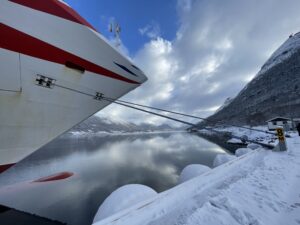
Last week we abandoned our narrowboat in a marina and headed for a bigger boat and more turbulent waters. We sailed on this ship 4 years ago, P & O’s Aurora, doing a return cruise from Southampton up the Norwegian coast to Alta, in search of the Northern Lights (and Trolls 😀).

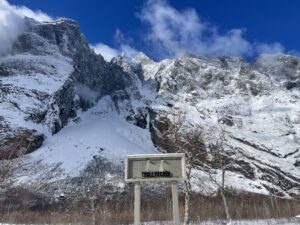
We’re repeating the cruise for two reasons, the first is to hopefully give Ian’s mum the chance to fulfil a lifetime’s ambition to see the Aurora Borealis, the second is for Ian to enjoy it this time, as last time he was rather poorly and spent half of the cruise in the cabin.
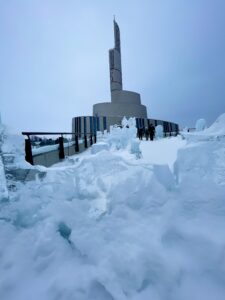
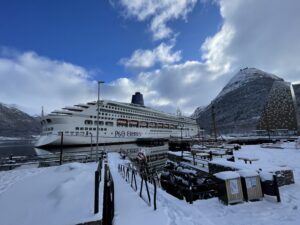
Currently, we are docked at Alta, Norway, our furthest northern port. Alta is 248 miles (400km) above the Arctic circle but is still 1,380mi (2,221km) south of the North Pole. It’s one of the best locations for seeing the Northern Lights. Unfortunately, the weather has turned rather blizzard-like. A local guide told Ian that this is some of the worst weather they have had here this year. Just our luck – we were supposed to be travelling to a remote camp to view the Northern Lights tonight, but the road up there is blocked, so our evening trip has been cancelled.
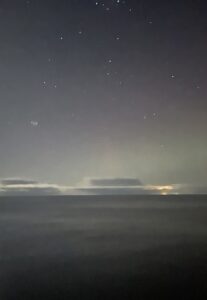
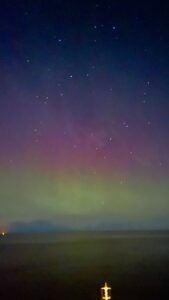
It’s always been a game of luck. For the best chance of seeing the lights, you need a high KP (measure of solar activity scaled 0-9) and a clear sky with the absence of either daylight or light pollution. The Kp-Index – derived from the German “Planetarische Kennziffer meaning “Planetary Index” – is a measure of geomagnetic activity in the Earth’s atmosphere. The colourful glow of the Aurora (also known as the aurora borealis or polar lights) is the result of particles from the sun releasing energy as they bombard the gases in the Earth’s atmosphere. When particles collide with oxygen, the aurora produces green and yellow, with nitrogen, you’ll see red, violet and occasionally blue. The red colour has historically been seen as a terrifying portent of war and bloodshed, a dramatic display appeared over the UK just before the French revolution in 1789.
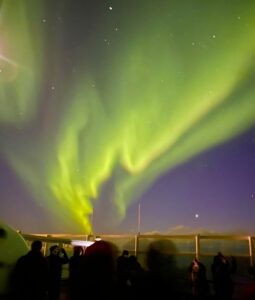
The northern lights weren’t called Aurora Borealis until 1621 when Galileo Gallilei named them, Aurōra is Latin for dawn and Boreas is Greek for the north wind.
There are many different legends about the Aurora Borealis.
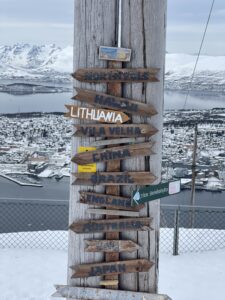
The indigenous population of the Nordic countries are the Sami people, one of their names for the lights is Guovssahas, meaning the hearable light. They believe that the Aurora carries the sounds of their dead ancestors. In respect of this, you should never whistle or
sing during a display, as you risk being whisked away by the lights, never to be seen again (apparently you can clap your hands to ward them off). The Sami also believe that a child conceived under the Northern Lights is blessed with both good fortune and looks. Ironically, a tradition of North American Indians is to whistle at the lights to draw them closer so that they will take a whispered message back to a loved one.
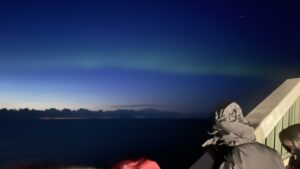
Norse mythology, believes that the Aurora is the Bifrost, the sky bridge between Åsgard (the land of gods) and Midgard (the land of humanity). Other stories suggest that the light is reflected from the shields of the Valkyrie, the female angels of death sent to retrieve fallen Viking warriors and lead them to Valhalla, Odin’s majestic hall in Åsgard.
Finally, in northern Sweden, it was believed that huge shoals of herring swimming in the northern seas created a spectacular show and promised a bountiful catch; so when the Aurora was up, it was time to get the nets out and go fishing.
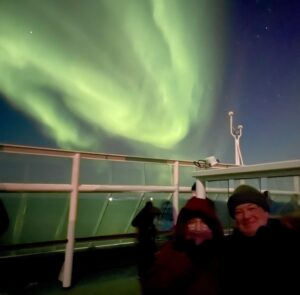
The flip side of our cancelled trip, the cost has now been refunded! So, it’s time for us to head off to check out the wine list!!! The blizzard is due to stop later with clearing skies and a potential KP of 4, so we might still get a peak at the Aurora later tonight.
Looks like a fun trip. Hopefully the food, accommodation and ambience makes up for the blizzard!
What a Wonderful adventure (x2).
Thanks for the educational input on particles & geomagnetic activity. Delighted you all got at least one viewing of the AB. 🥰
What a fabulous trip! Thanks for sharing🙂