
The canals often form long green corridors which are screened from the surrounding countryside by hedges and trees, so you don’t always realise what you’re going past. As we headed up the Llangollen a few weeks ago, we spotted a sign for the Mammoth Tower and decided to stop on our way back.
 We had no idea what we’d been cruising through or on for that matter! We’ve cruised this way several times and never bothered to stop. We knew the land was flat and the canal was straight and raised up, it seemed a bit boring. We had no idea what was going on or how wrong we were.
For starters, we discovered that the canal was actually built on a raft that allows it to “float“ across the peatbog, an area which stretches over 2,300 acres. This boggy peat land caused a massive headache for the canal engineers (Telford and Jessop) when they were constructing the canal. So instead of the expense in time and money of going around it, they decided to float the canal over it.
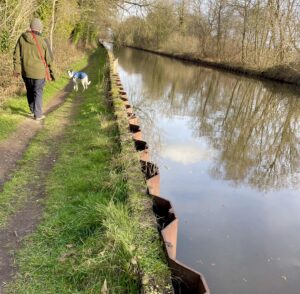
In the early 1800s, they lowered the water table of the Whixall and Bettisfield Mosses by creating big ditches and draining the land, then they formed the raft for the canal to be built on. As this would be prone to collapsing, a team of navvies (navigation workers) were employed to continuously monitor and reinforce the banking around the floating canal. These navvies became known as the Whixall Moss Gang and their worked continued for nearly 160 years, from 1804 until 1960, the Gang became the longest serving group of navvies on British canals. In the 1960s this floating section was underpinned with sheets of steel piling to stop it from collapsing. Two breaches have occurred, but on both occasions, these have been attributed to the weakening of the bank by burrowing animals, mainly badgers.

When we eventually reached the Mammoth Tower we discovered that it was a viewing platform on the edge of a huge National Nature Reserve overlooking the Mosses. Natural England are in the process of raising the water levels to allow the peatland to regenerate as a raised peat bog, a bit like allowing a dry sponge to soak up water. The peat that remains has tell-tale signs that indicate how the peat was extracted for over 500 years. Originally cut by hand under the license of the Lord of the Manor, it was used for fuel, distillation, animal bedding and packing. Then during the 1920s the extraction rate was increased, and larger quantities were used for agricultural fertiliser and garden compost. The cutting became mechanised in the late 1960s and by the late 1989 the rate had quadrupled causing a public outcry. The resulting campaign led to the central area of the Mosses being declared a Natural Nature Reserve in 1990.
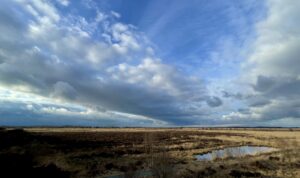
Evidence of peat cutting remains on the Mosses as does the old narrow-gauge tramway that used to transport the harvested peat to the derelict Old Fenn’s Peat Factory. The Military have also left their mark on this land. During World War I there were over 20,000 troops in Camps around the area; large rifle ranges were set up for training Kitchener’s New Army and this included an onsite base camp for 1,000 soldiers. During World War II, a bombing range was added for the local flying schools and it was also set up as a secret Strategic Starfish site. The Starfish sites were created during the Blitz and were large configurations of multiple fire baskets, lit at night to simulate nearby towns or cities, acting as a decoy to night time enemy bombers.
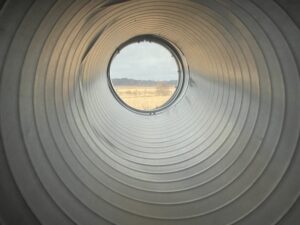

I think we were both surprised and a little shocked by what we learnt as we wandered along the nature trails and read the signs. Ending up back at the Mammoth Tower we had an amazing vantage point to view the landscape. Even at the end of winter, the Mosses have a remote and rare beauty that simply takes your breath away. Whilst mammoths roamed here during last ice age, and past human activity has left its scars, this peatland is now quiet and home to a wealth of life.

My goodness there were some tremendous feats of engineering in the nineteenth century! What an jnteresting blog, thanks.
Thank goodness for Natural Nature Reserves.
Never heard of a floating canal before… but they made it work.
Brilliant that you stopped off to check this gem that might easily have been overlooked. Great pics and blog.
Just worked out the periscope…. ( deh) not everyone wants to climb the stairs !
Loved your blog on this. Like you I cruised past this yesterday with no idea of what it was or that I was on a floating canal! Thank you for researching this – it’s beautifully written and a really interesting read.
Hi Sarah, thank you for your very generous comments, I do love finding out more about the canals that we cruise on x