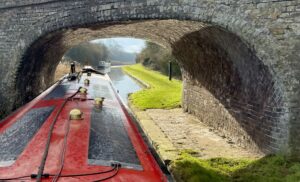
We’re heading west and need to get to the Shropshire Union Canal. From here the only way west is the Middlewich Branch of the Shropshire Union.
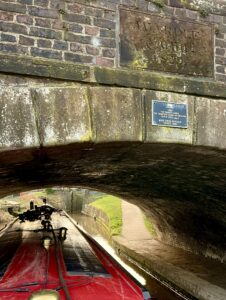
Originally planned in 1760 this canal branch wasn’t built until 1827. It’s 10 miles long with 3 deep locks (at least 3m) and stretches from Barbridge (north of Nantwich) to Middlewich, where it suddenly stops within sight of the Trent & Mersey Canal. An act of parliament prevented this canal from coming within a 100ft of the T & M. Any cargo for the Potteries or Liverpool had to be off loaded and reloaded onto the waiting barges on the T & M. It took 2 years and the approval of parliament to make the Trent & Mersey Canal Company build a link to join the two waterways. This was named the Wardle Canal and is literally only 47m (164ft) from the junction bridge to the lock gate. As compensation, the T & M charged exorbitant tolls until 1888 when a new act of parliament abolished the tolls.
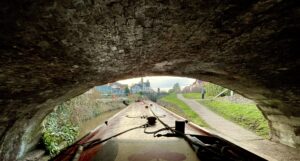
In the summer, the junction becomes a bit of a bottleneck and gets very busy. It’s a prime spot for gongoozlers to watch boats make the blind turn under the bridge and try to get into a lock that has no landing. Ten years ago, Wardle Lock Cottage was the home of Maureen Shaw. Maureen was a well-known boatee. As a young child, Maureen was taken in by a pair of boaters and grew up on their barge transporting gas oil from the Manchester Ship Canal down to gas stations in Wolverhampton and Banbury. She learnt how to control the horse by using bread in one hand and cheese in the other. Maureen retired to the lock cottage and became an unofficial lock keeper. She had a ready smile, always keen to help anyone who needed it and to give advice to passing boaters, including us on one of our first holidays on a hire boat. It was in this way that she made friends with people from all over the world and the lock became known as “Maureen’s Lock”.
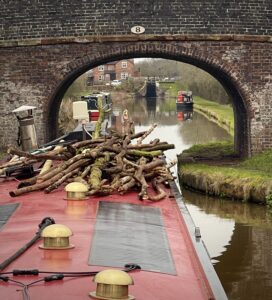
During the 1800s, railway companies gradually bought up many of the canals and the Middlewich Branch was no exception. At one time it was owned by LNWR (London and North Western Railway) and became the site of an experiment to combine the two styles of transport. In 1888, a mechanical engineer had an idea to run a trial with a small locomotive hauling barges along the canal. A one-mile length of narrow-gauge railway track was laid along the canal near to Worleston and an engine was brought up from the Crewe railway works. The tests were successful, with the little engine managing to pull 2, 4 then 8 barges at speeds up to a staggering 7mph. A full report was compiled by a canal engineer, but no further action was taken. One concern could have been that this excessive speed creates a big wake, the wash from the wake would damage the sides of the canals causing them to weaken and fail. Hence the current speed limit of 4mph; we tend to average around 2.8mph or a fast walking pace, it stops the ducks from bobbing up and down too much.
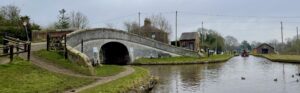
And talking about canal banks failing, the most vulnerable stretches to breaching are along embankments where damage caused by water voles can weaken the edges. On 16 March 2018, just outside of Middlewich, a section of the bank, over an aqueduct, failed and collapsed. The 3 million gallons of canal water, that had been between two locks, drained away into the River Wheelock below, leaving 14 narrowboats stranded. It took over 140 lorry loads of “reinforced earth” to replace the 2800 cubic metres of soil. The repair bill was over £3 million and took 9 months to complete (including repairs to a badger set that was discovered on site). What caused this devastation? An investigation concluded that all the paddles on the lock upstream were either opened maliciously or accidentally, and this meant that the canal overflowed. The embankment then failed, creating a tsunami flowing down into the River Wheelock below.
The embankment is, once again, a lovely spot to moor, but I’m mildly surprised and slightly worried, that they haven’t installed anti-vandal keys on the upstream paddles. I’m just saying, it could so easily happen again!

More amazing facts on the canal well travelled !
Who has heard of gongoozlers? Have I led a sheltered life?
Thank you for compiling and sharing another interesting blog to us landlubbers 😊
From Cambridge Dictionary –
“gongoozler”
noun [ C ] UK informal
UK /ɡɒnˈɡuːz.lər/ US /ɡɑːnˈɡuːz.lɚ/
a person who enjoys watching boats and activities on canals (= long, narrow, artificially made stretches of water):
Fascinating stuff, thanks for sharing.
Amazing. Love it Heather xx