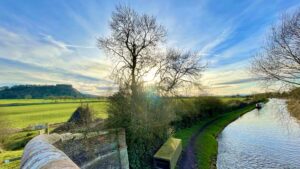
We’ve taken a little detour so that Ian could climb up the nearest hill!
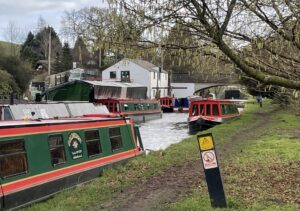
This time we had to negotiate the Bunbury staircase and scoot past Chas Hardern Boat Yard, once the terminus of the Chester Canal (previous name for this stretch of the “Shroppie”).
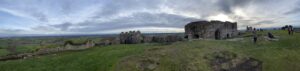
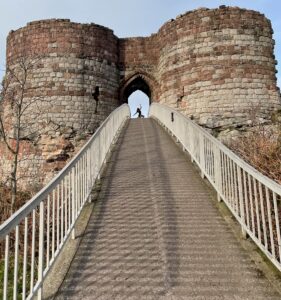
The hill, or rather the rocky sandstone crag, is the site of Beeston Castle, a rather imposing edifice that overlooks the Cheshire Plain. This distinctive landmark has been inhabited for over 4,000 years and boasts the remains of a medieval castle and a replica Bronze Age roundhouse. The replica roundhouse was built using Bronze Age tools and techniques and is modelled after the remains of seven roundhouses that were found by archeologists excavating between the Outer Bailey and Castle.
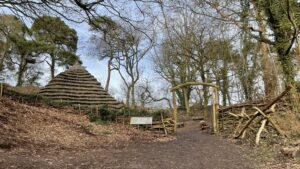
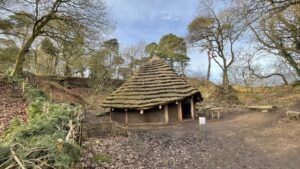
It has a very long history including being an iron age fort, a prison for Welsh hostages in the 13th century and in the mid 1600s, it was besieged by both the Parliamentarians and the Royalists during the final years of the Civil War. The castle was originally built for Ranulf de Blondville, but eventually became a Royal castle when it passed into the ownership of King Henry III who gifted it to his son, Prince Edward. The views from the top are well worth the 350 ft (107m) climb and at the bottom is a rather nice café!
Within sight of the castle are some rather curious bumps that look like empty missile silos. They are reminiscent of the Greenham Common Air Base that we used to live near to, except they’re not! They are, however, part of a huge, decommissioned WWII Bulk Fuel Installation. Some of the tanks are open and exposed, but the pipes and support structures are still inside a few of them.
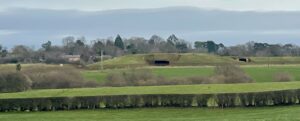
Years ago, when we first saw these “caves”, I thought they were disused armouries that were now being used to store wine or cheese. That was rubbish. They are on private land; the landowner keeps red deer in the fields around them and is very protective of his grounds (you have been warned!). The tanks were storage for imported oil and bulk fuel from the Stanlow Refinery at Ellesmere Port and were connected to PLUTO (Pipe Line Under The Ocean). These storage tanks were part of a chain that linked fuel stocks across the country and supplied fuel for the D Day Normandy Landings in 1944.
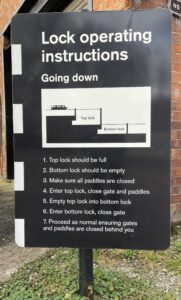
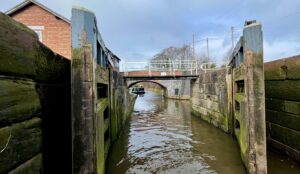
Although we’re less than 20 lock/miles from Chester, it is not our current destination, so we’ve turned around and headed back though the Bunbury Staircase. Two locks which are joined together, having three sets of gates and paddles. The height of the middle lock gates is quite intimidating, but thankfully there are footbridges, so you don’t have to walk across the gates to operate the lock!
The contrast of the buildings and the history of this little area of Cheshire has been quite an eye opener and well worth the little detour.
A pretty cool place, Ian must have been through this area with me on the Cheshire Hike(S), but great that you now have the time to stop and look and find all the very interesting bits..
It certainly is great to have time to discover what’s here, it’s been quite an eye opener!
Thanks v much for your interesting blog.
Relived there was a nice cafe to reward your exploring efforts 😊 ☕️
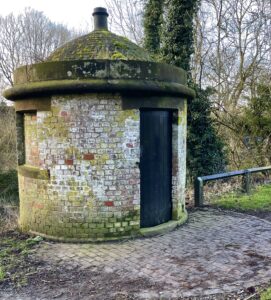
The lock keepers hut 🛖 doesn’t look that inviting for a day job, but might be ok for weather protection.
Another great and interesting blog. I hope to be invited to join a voyage on an electric powered boat this year. Not sure where we will be sailing yet. The boat is near Bristles.
Hope you enjoy the experience. I’d love to have a hybrid and avoid the noisy diesel engine!