Of mountains and seashells

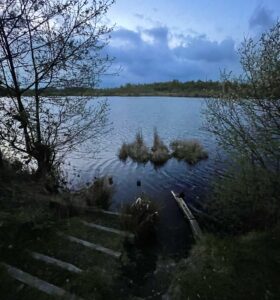
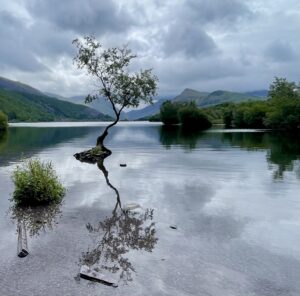
The lone tree on Llyn Padarn

The valleys and mountains of the Eryri National Park (formerly known as Snowdonia) is an area that holds many memories for both of us. Revisiting it with more time to explore and soak up the surroundings has been a real treat.
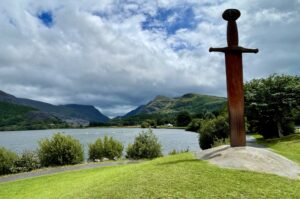
Llanberis

As Scout Leader’s daughter, I spent many summers playing in the rivers and woodlands on summer camps in North Wales. Ian visited them as a Scout and on family holidays, and we also have joint experiences and memories as Venture Scouts doing various walks and backpacking expeditions.
One of these involved traversing Crib Goch, with full backpacks. It’s a very sharp shoulder ridge on the east side of Yr Wyddfa (Snowdon) with drops of hundreds of feet on either side. Not a hike for the faint hearted and not one that either of us ever intend to do again (I still have nightmares from the first time). Ian was keen to get to the summit again, but this time he chose the easier route of the Miner’s Track, a good idea given the variable weather conditions and having a daft dog on a short lead with a death wish!

Looking back towards the Miner’s Track

We spent some time camped near to a village called Cwm-y-glo, near Llanberis. Just on the edge of this village, there’s a rather unassuming plaque on a rockface by the road. It commemorates the site where, on a hot June day in 1869, six people and horses were tragically killed when two carts, each carrying a ton of liquid nitro-glycerine, suddenly exploded. The canisters had been packed in straw and travelled all the way from an Alfred Nobel factory in Germany. The carts were within a couple of miles of the slate quarries at Llanberis when they blew up, the explosion was felt in Holyhead, on Anglesey (23 miles away) and created two craters about 10ft deep (3.3m). There’s a X marked on a stone wall, over half a mile (800 metres) away, where a wheel and the harness of one of the carts were found.
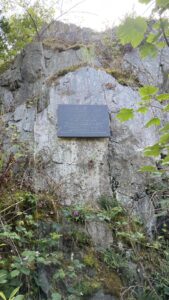
Roadside plaque near to Cym-y-glo

As a result of this terrible incident, an Act of Parliament was written prohibiting the import of nitro-glycerine and regulating its carriage. Quarries and other industries replaced it with dynamite, a more stable material manufactured for the first time by Alfred Nobel in 1866. When Nobel died in 1895, he left instructions in his Will to fund the annual awards of the Nobel Prize in five categories to “those who, during the preceding year, have conferred the greatest benefit to humankind.” Over the last 122 years the Nobel Prize has been awarded 615 times to 954 individuals and 27 organisations.
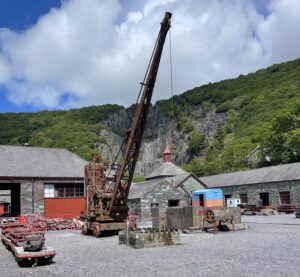
The National Slate Museum near Llanberis

That awful event certainly changed the law relating to the transportation of explosive materials and perhaps incidents like this may have prompted Nobel to establish his Prize. Whatever you believe,  I do find it quite bizarre that in the most obscure and unassuming places you can suddenly find something that has had such far reaching repercussions.
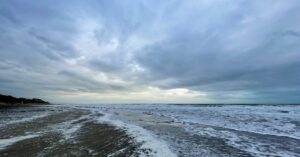
Stormy seas on Shell Island

After all this drama, we headed to Shell Island, near to Harlech, to hunker down for a few days of stormy weather. We were very glad to have our motorhome to shelter in as the wind gusted towards 50mph with driving rain. Unfortunately, as this weather lasted for a few days, this was too much for many of the tents and many campers left with the site skips being filled with their canvas and broken poles. During a few hours of calm, we did manage some walks along the coast and swimming in the sea. The last day was picture perfect sunshine and after a final dip in the water, we headed home with its warmth on our skin.
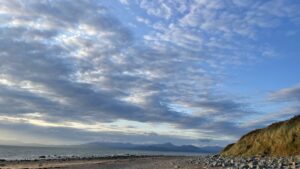
Holed up on the L & L

Shades of green

We knew there would be problems with water levels on the Leeds & Liverpool canal, but water shortages and broken bridges seem to be affecting quite a few parts of the system at the moment.

Bosley Locks-Sept 2019

The Macclesfield Canal has a lack of water and has closed its main flight of locks at Bosley, the Peak Forest Canal has a broken lift bridge which is causing a bit of a headache for boaters up near to Bugsworth Basin, including Holly the Café boat, Holly is stuck on one side of the bridge and their accommodation boat, Zero, is on the other. There are also water resource challenges on the Huddersfield and the Rochdale and we were lucky to get up the Wigan Flight before they shut it for repairs. And to cap it all, there’s a section ahead of us which has developed a breach. 

Fluffy cloud days

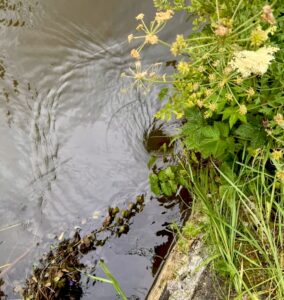
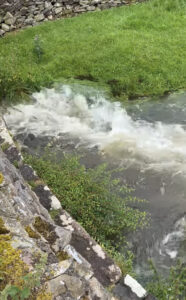
Bearing in mind that these canals are 200 years old, it’s not a complete shock that they have taken on some damage and sprung a leak. The weakest points do seem to be worn-out locks, overwhelmed embankments and collapsing culverts. That’s what’s happened here, it just looks like someone has pulled a plug, it only looks like a small whirlpool from above, but the volume of water running off is scary.

A small whirlpool gives away the location of the leak
Underneath is the true situation, gallons of water escape across the fields

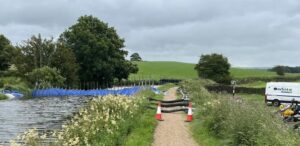
As you can see from the pictures, CRT have already built a dam on either side of the breach ahead of us and they are pumping water around it to raise the water levels downstream. 

Emergency dams to maintain water levels
Access can be an issue when the breach is out in the countryside

It’s no one’s fault, it’ll be a combination of seepage and damage caused to the culvert by storm water and debris gradually washing out mortar and stonework. The downward pressure of the canal water weakens the damaged structure and can eventually cause the breach. Any boats in this section of canal will just see the water level drop and will be grounded until the breach is fixed. It is a bit of a worry that one day it’ll be our turn and we’ll be the ones waking up to discover out boat is at an horrendous angle sitting on the bottom of a dry canal. I have huge sympathies for anyone that this has or is happening to.

A quiet spot on the outskirts of Burnley

Having guardianship of the 2,700 miles of navigable waterways must be a bit of a nightmare. At 125 miles, the Leeds & Liverpool is one of the longest canals in England and seems to be having at least one major breach every year. Given the vast distances involved, the speed at which the Canal & River Trust respond to an incident is impressive. Repairs can be time consuming and expensive, but they get on with the job and do whatever they can to mitigate the situation for boaters in the vicinity.

Walks in the local area – Castle Clough 
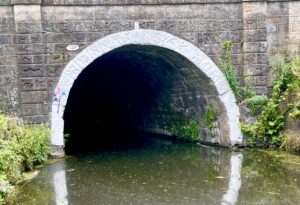
Curious carvings on Gannow Tunnel


Despite all of this, we are loving this way of life, you literally have to go with the flow! As it happens, we weren’t planning to go much further for a few weeks. The boat is tied up in a marina under the shadow of Pendle Hill and we’re heading off into the hills on four wheels. Hopefully by the time we get back from our travels there will be progress with the repairs.

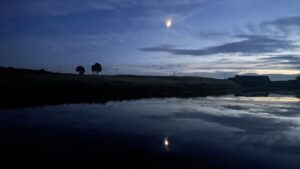
Moonlight on the L & L

Halfway there!

First swim

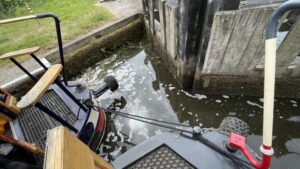
We’ve had a relaxing couple of weeks since our dash up the Wigan flight of locks. We were also very lucky to get up them when we did as, a few days later, various issues with leakage in one of the pounds (pools between each lock that store the water) caused boats to ground on the stone cill in the lock. This cill is now damaged or “blown”. The cill leaks so much that it can’t be operated. This will take weeks to fix as the canal has to be dammed to allow for the stonework to be rebuilt. I feel very sorry for all those boaters who were planning to travel that way during June/July.

Withnell Fold Paper Mill

It’s been a relief to take it easy in the heat and thunderstorms. We’ve now passed through Adlington and Chorley – yes, we did buy some Chorley Cakes and we did demolish them as we cruised on. Some members of my family call these cakes Fly Pie and we are divided by those that will eat Fly Pie and those that refuse. I never knew where the term Fly Pie came from, I thought we’d just made it up as currants and raisins look just like dead flies!

Chorley Cakes

Apparently not, Fly Pie is what the locals in Chorley, Lancashire, call the Chorley Cake. A 3-5 inch round flat cake made from a sandwich of unsweetened shortcrust pastry filled with a thin layer of raisins. But wait, here’s a surprise, Ian remembers his grandma (Yorkshire born and bred) making a Fly Pie that was different again, this was more like an enormous flatter, square version of a Chorley Cake with icing sugar on top. It turns out that there are many Lancashire cakes which combine dried fruit and pastry, everyone knows of the Eccles cake but what about the Sad Cake. It’s sort of like a Chorley cake but rolled flatter and a speciality of East Lancashire.  Sad Cakes date back to 17th century, cooked on a hot griddle and put in a workman’s lunch box as a filler, they were eaten as a snack or a desert after sandwiches. Unfortunately, unless you got your Chorley Cake from a local baker in Chorley, it was probably baked in a factory in Burnley much to the disgust of the townsfolk!

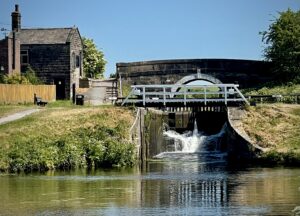
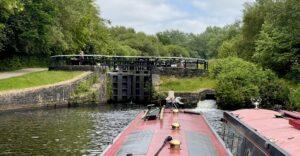
Lock 61 on Johnson’s Hill Flight

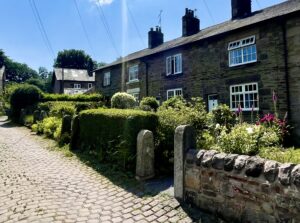
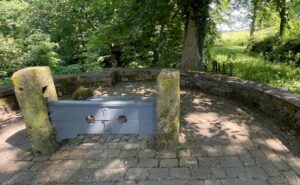
So after that bombshell, it’s time to press on upwards and onwards to Leeds. The seven locks of the Johnson’s Hill flight were lovely, a bit like an upscale version of the Bosley Locks on the Macclesfield Canal, with stunning scenery and helpful volunteers. The construction of this wider canal attracted a lot of industry. The bigger towns grew up around industries such as huge cotton mills, but along this stretch a lot of the factories were either paper or printing mills. Withnell Fold is a model village built in 1843 by a mill owner for his papermill workers. It’s not as big or as grand as Saltaire in Yorkshire, but it has retained its charm with cobbled lanes and the necessary village stocks.

Cobbled lanes of Withnell Fold
Village stocks


Nearly half way

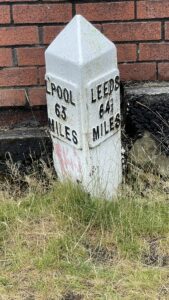
We’re making slow but steady progress, enjoying the contrasting scenery and the lovely weather. We’ve been spotting the white mile markers as we’ve gone along the Leeds and Liverpool Canal, but to our astonishment, Church, a village between Blackburn and Burnley, seems to be very proud of its location.


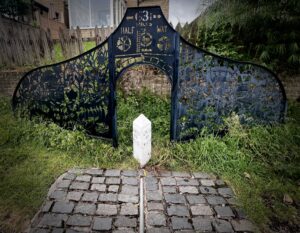
It’s the first time that we’ve seen such homage paid to a halfway point, apparently, 63 5/8 miles is the magical point between Leeds and Liverpool-there’s even a metal rod, like a meridian line, embedded into the towpath!

That’s a fine line between Leeds and Liverpool!


Up the Wigan!


Skilfully avoiding the by-wash at lock 75

We‘ve made it up the Wigan flight, we had coffee and cookies ready on the back and we paired up with a single-manner (boat with only one person on it). It was the first time for me to helm a pair of boats breasted up. Once we’d got up into the first lock of the flight, we used the bow and stern ropes to secure the two boats together and then I had to learn on the job! 

Boats tied together

Getting 30 tonnes of boats moving from stationary with only a 38hp engine is a slow and gentle manoeuvre whilst conversely, stopping two 15-ton boats with just rope holding them together is another feat in itself as inertia likes to play a game of drag the boat!

Big locks, some with bracing to maintain width

We were going uphill, so the locks were empty and looked huge with massive stone cills at the end of them. Steering the boats straight at these blocks of stone was a bit daunting, but by the fourth (or tenth!) lock I’d just about learnt how to allow for the inertia of the second boat trying to drag both boats into the lock at the front or the bounce in the ropes acting like a giant rubber bands and catapulting the boats backwards out of the lower gates. (As far as me and Tony, our friend for the ascent, could tell, it looked like Heather had been doing this for years! – Ian)

Heading up the flight

When we’re doing a set of locks, Ian and I usually swap around between being on the tiller and steering, and being on land managing the locks. To be honest, once I’d realised how big these locks were, I was happy to do the helming and avoid the dizzying heights of the gates and empty lock walls. I was also surprised by the local passer-bys taking photos and calling out to ask me how I was managing the two boats on my own. I had wrongly assumed that a lot of boaters paired up like this. Admittedly we’ve only done it once before and that was on the Caen Hill flight of 17 locks on the Kennet and Avon Canal. Ian was the helm on that occasion, it takes a brave person to allow someone else to have full control of their precious floating home, and some locks have warped too much to accommodate the width.

Haigh Woodland Park

So for those who like numbers, it took us just under five hours to navigate 2 miles of 21 locks, taking 30 tonnes of boat up 200ft (61m), the same height as 20 African elephants or a 20 storey building. Thankfully we did the flight last week before the heat wave arrived and since then we’ve been moored up next to Haigh Hall Country Park. It is surrounded by a great woodland park with lots of walks through the plantations. It’s also next to a golf course that comes down to the canal- note to self- don’t moor your boat near to a white pole with a pretty little red flag on it!

The walled garden at Haigh Hall Country Park

Now we’re into June and not only has the hay fever season started for both of us, but the horse-flies are on the attack again. I’m off to find recipes for homemade insect repellent as the little buggers love to bite me!
A red dawn on the Leeds and Liverpool

And… we’re back!

Looking towards Appley Locks

Our motorhome travels are over for a little while, so we rescued the boat from the marina and, with a slower speed in mind, headed back along the Leeds and Liverpool Canal towards Wigan, but only as far as Appley Bridge. 

Beautiful swathes of May bluebells

Appley Bridge sounds like a sleepy little idyllic spot, but it has seen some eventful moments. In 1914, a farmer’s field was the landing site for a 15kg meteorite and there was a severe flood in 1987, but one residence has a rather bizarre history centred on a skull that has lived above the fireplace for centuries. The cottage is called Skull House and was allegedly the hiding place for a monk who took refuge in the chimney. On being discovered, he was smoked out and killed.  His head was placed on the mantlepiece as a warning to others. Ill-fated stories describe how subsequent occupants of the house have tried to remove the skull. One threw it into the River Douglas, but the skull returned to the house and resident was found drowned in the river. Another took the skull far away from the house, but again the skull returned, and the resident suffered some nasty injuries after a fall down the stairs. Further efforts to remove the skull have allegedly resulted in episodes of bad luck, sickness or death. Apparently, the current owners have, perhaps wisely, kept the skull in situ. 

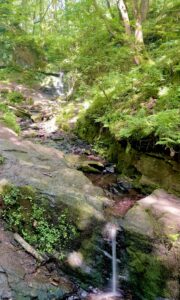
Fairy Glen, Parbold

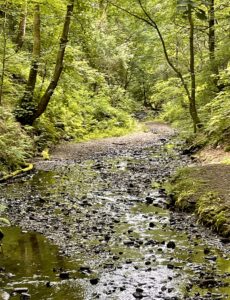
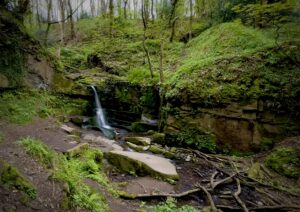
There’s a lovely little clough nearby called Fairy Glen, it’s an ancient broadleaved woodland with multiple trails and cascading streams and waterfalls. We’re lucky to be moored so close, it’s a big attraction due to the rich biodiversity, but finding car parking is a nightmare.


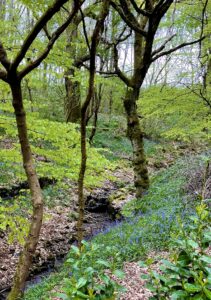
Listed as a Biological Heritage Site for its oak, birch, ash, and alder, the woodland floor changes with the seasons. On our first visit, we were fortunate to see the carpets of bluebells with their heavy scent competing with the pungency of wild garlic. Now into late May it’s the turn of the ferns and red campions.


Gunwales and back hatch repainted

It’s also that time of year when we touch up some paint work on the boat (I’m thinking of re-naming her “The Forth Bridge”) and here I offer a sincere apology to anyone who passed by our boat during this time and found me a bit grumpy. It was like a magic wand, whenever I tried to paint a delicate edge on the back hatch (it’s a club shape inside a curvy box), boats would appear from different directions, or Ian would need to get on/off the boat, causing a rocking motion. It’s my excuse for the wavy lines and exasperated tones from me. We were more successful with repainting the gunwales, but we’re far from doing a professional finish. However, as Ian says, it’s now our style of paintwork, it has that shabby chic look and is very practical at limiting the build up of rust. As they say, don’t look too closely and don’t give up the day job! (what day job!!)
A hazy sunny evening

Spending time in one spot is lovely and relaxing, especially with the glorious weather that we’ve been having,  but it does have a time limit. Eventually we start to run out of water, run low on food and need access for waste disposal. So, in a few days we’re off to tackle the 21 locks of the Wigan flight, it’ll take most of a day to do them and you can’t really stop once you’ve started. They are big double width locks, which are much easier to manage if there are two narrowboats in the lock together. We’ve signed up to the Facebook group where people look for a second boat to pair up with and I’m going to bake a batch of cookies to say thank you to the lovely volunteers that we hope will be there to help us through the flight.

Shades of green, mooring close to Appley Bridge

Tors and Moors


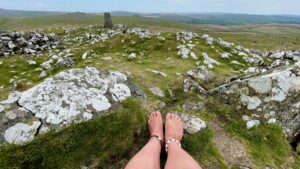
The Barefoot Boater on Dartmoor

We have both fallen in love with Dartmoor, it’s about the size of London. For Ian, it’s the wide-open spaces and for me it’s the rocky, blobby piles of weathered granite tors. We’ve had fabulous blue skies and a countryside that’s positively glowing with colour in the late Spring sunshine. Dartmoor is an ancient landscape bursting with life and legends. As we drove over the moors, I’d never seen so many moorland ponies, hardy looking cattle, and sheep paying no heed to vehicles or cyclists!

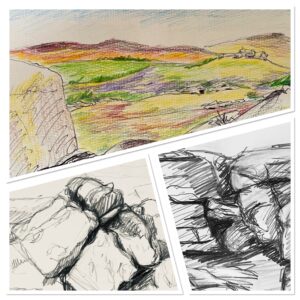
Sketches from Haytor Rocks
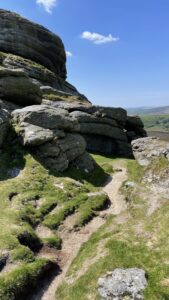
Paths between the rocks on Haytor


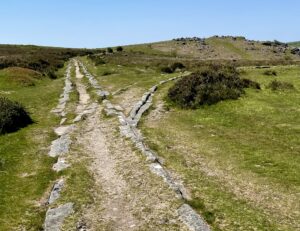
We headed to Haytor and Ian disappeared off with the dog for a barefoot wander, while I indulged my passion for sketching rocks.  The valleys are scarred with old quarries, the one near to Haytor was of such high-grade granite that it was used to build monuments in London, including Nelson’s Column, the old London Bridge (which is now in Lake Havasu City, Arizona) and the British Museum. The stone was transported from the quarry down an 18-mile-long tramway (known as Templar Way) to Stover where it was loaded onto ……wait for it… barges on the Stover canal that ended at the sea port of Teignmouth giving easy access to ships and a global market. The now disused quarry is home to a sheltered pool of clear water that is a known wild swimming spot.

Templar Way, tramway from Haytor Quarry

I think we’ve both been surprised by the beauty of this moorland, it is far from the desolate empty space that I’d imagined. There’s so much to explore and wild swimming to try at Haytor Quarry, so we are already planning a return visit, even though the roads are rather challenging for a motorhome of Hollie’s dimensions (yes that’s the name that I keep insisting we use!!). 

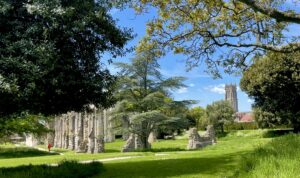
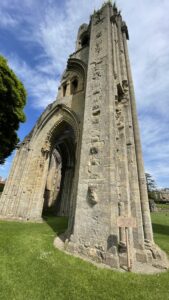
The grounds of Glastonbury Abbey


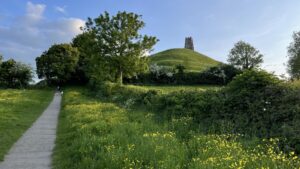
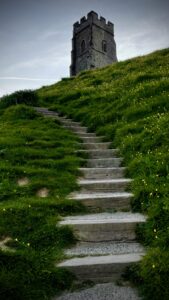
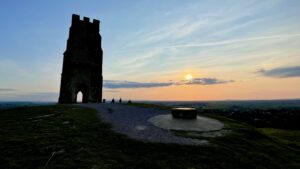
We’ve now scooted onto Glastonbury. After wandering around the town and the grounds of the ruined abbey, we’re camped close to the base of Glastonbury Tor. I foolishly thought this was just another Victorian folly and had no real history to it, but it’s actually the remains of the 15th century church of St Michael.


Approaching Glastonbury Tor

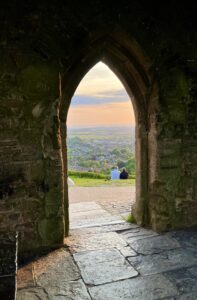
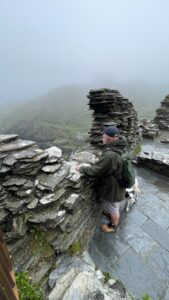
During the day there have been people dotted along the skyline climbing the rather steep and winding steps to the church tower. We walked up in the evening, it was well worth the view, especially at sunset. If there’s any kind of a gentle breeze, when you stand inside the tower between the open arches, the wind strengthens. It blew so hard that it took my hat off. The sun lowered to the sounds of chanting and drums beating, there was an inexplicable sense of reverence about the place.

Inside the tower of St Michael
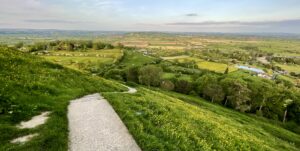
Views across the Somerset Levels

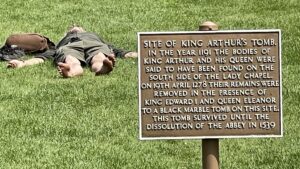
Glastonbury aka the “Isle of Avalon” is (allegedly) where King Arthur retired to after his last battle. His remains were miraculously “found” in the grounds of the abbey soon after a costly fire had devastated the site in 1191. Under the gaze of Edward I, Arthur’s remains were reinterned inside the abbey, thereby generating enough cash from tourism to repair the damage.

Homage to Arthur’s tomb

Our adventures down south are over for now and we are slowly heading home stopping en route in the Malvern Hills. It’s been great and we will be back!
(I’m still gutted about King Arthur)

Sunset from Glastonbury Tor

A postcard from Cornwall

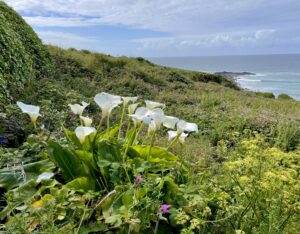
Wild Arum lilies on the Cornish coast path

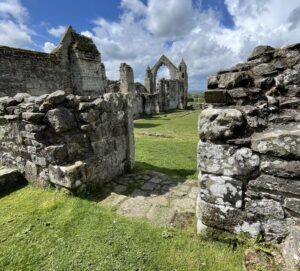
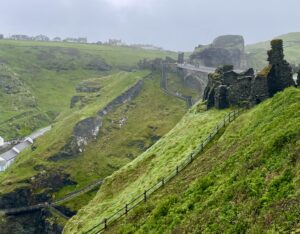
We’ve moored the boat in a marina, jumped into the motorhome and headed south towards Cornwall. We planned to stop off in the Shropshire Hills on the way down. Our first choice of camp location was waterlogged, so we found ourselves parked up at a campsite on Ebury Hill, previously an iron age fort. It has outstanding views over the Shropshire countryside and when the sun was shining, we chanced a walk along the Shropshire Way to the beautiful ruins of a 12th century abbey. This was our first taste of medieval history on this trip and it set me thinking about an old book that I’d seen as a child filled with the most amazing colour prints of dragons and knights. Of course, this was a book about King Arthur, and we were heading to Tintagel and the island where Arthur was born and built his legendary Castle, Camelot.

Haughmond Abbey
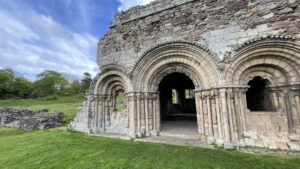
The Chapter House at Haughmond Abbey


Except he didn’t!! What? Skip these paragraphs unless you’re prepared for disappointment. For starters it seems that castles didn’t appear in Britain until 500 years after Arthur. The ruins that we see today are the remains of a slate castle that was first built in the 13th century by Richard, Earl of Cornwall. A rich man with a romantic heart, his motivation to create a castle for Arthur was possibly from a newly published Book of Kings by Geoffrey of Monmouth. Geoffrey created the first account of a life story for King Arthur, stitched together from various myths and facts.

Looking back from the castle towards the mainland


Arthur himself was likely a rather rough looking warrior as there was no shiny armour in the late 5th and early 6th Centuries AD, he would have been dressed in cloth and furs. This medieval Arthur did exist and was a prince who led British forces against the Saxons. His prowess in battles was exaggerated but as a talented fighter he provided an inspiring figurehead for the armies and was a conquering hero.

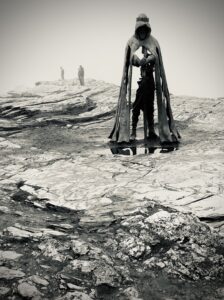
Gallos statue – is this King Arthur?

During the time that our legendary King Arthur should have been conceived on the island, it was actually a thriving trading harbour for goods from the Mediterranean. Remains of simple medieval, rectangular buildings used to store the goods can still be seen along with collections of glass and pottery from that period.
I’m a little disappointed that my shining knight never existed, but surprised by how old the story is. It’s fascinating that our passion for a good story can give so much credence to a name and international fame to a rocky outcrop.

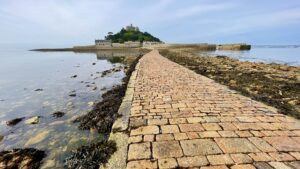
The causeway to St Michael’s Mount

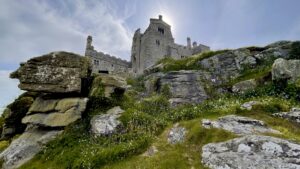
Further round the coast, the 15th Century castle and chapel of St Michael’s Mount dominates this shoreline. Close up the granite stone buildings look pristine (even the gracefully curving causeway has only one pothole!). Which is possibly why the castle has appeared in numerous films such as Dracula in 1979, Johnny English in 2003 and House of Dragon in 2021.

St Michael’s castle
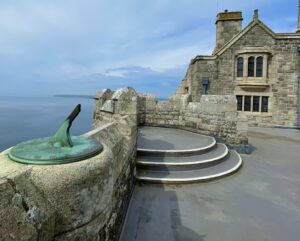
The rear court yard of the castle

A 6th century legend describes the first habitant of this rock edifice as an 18ft high Giant called Comoran who terrorised the local villages. He was slain by a farmer’s son called Jack and you can find the heart of the giant as you walk up the cobbled path (it is small, but the guides usually mark it with fresh flowers every morning). Since then the island has been a priory, a garrison and a stately home. Inside the castle are remnants of over five hundred years of occupation including minute pieces of Napoleon’s uniform and some impressive Rococo decor!

The giant’s heart hidden in the cobbles
The remodelled Lady chapel


This has been a trip of 2 halves, so far. Torrential rain and getting stuck on waterlogged fields – twice! Followed by sun and blue skies, swimming in the sea and walking the coast path – barefoot for Ian. 

We are now on the Lizard, the furthest south you can go in the UK.  The sun is shining, the wind is light and we’re off exploring again. If you’re down this way and feeling peckish, our best tip for eating fish and chips is to have a friendly dog nearby to scare off the seagulls!

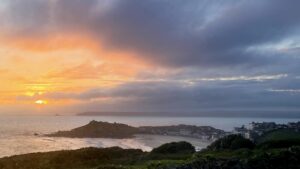
Dawn over St Ives

Heather’s ancestral home

The Old Stanley Locks

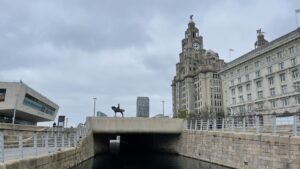
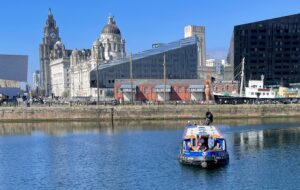
We made it to Liverpool. There must be a popular sport associated with this place, as we passed 20 footballs floating in the canal! We also had to go down the weed hatch a few times (I say we, I do mean Ian!). Stuff that has fallen into the water can get wrapped around the propeller, this time we had a pair of underpants, a cushion and a shirt. The cityscape shows a dramatic contrast between old and new architecture, both in style and materials. Within the last twenty years there’s been a huge regeneration of the docklands. On a narrowboat you enter the heart of Liverpool via the Old Stanley Lock Flight close to Vauxhall. These are series of four massive locks and we were very grateful to have volunteers helping us through them. The flight descends from the canal into Stanley Dock. You then follow a new channel known as Sid’s Ditch, named after a 36 year veteran Canal and River Trust worker who still looks after boaters (and us) in Liverpool. Finally a couple of new locks give access to the 3 new tunnels that bring you under the new waterfront by the Liver Building (it was quite daunting, but very exciting).

Navigating the new waterfront
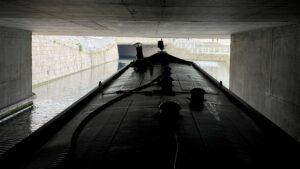
Passing through the new tunnels

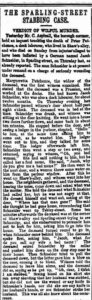
The city is steeped in history. For hundreds of years, it was one of the main British ports, having strong links (literally) to the canals and, as it turns out, to Heather’s family. She’s discovered that, from the 1700s, generations of her family worked as coopers (barrel makers) in Liverpool, and from the mid 1800s she’s also descended from German immigrants who came to work as labourers in the docks. What has been distressing was to discover the tragic early death of her Great Great Grandfather in 1875. Peter Patchence, an immigrant from Prussia (in what is now Germany), was stabbed on a street corner by a fellow German dockhand. The perpetrator was taken to the local bridewell (police holding cells) before being formally charged with wilful murder. The details of what happened were recorded at the Coroner’s Court and reported in the The Daily Post. Click on the picture below to view the complete newspaper page; look for “THE SPARLING STREET STABBING CASE” (top of 2nd column) we’ve included the whole page of the paper as it gives a fascinating snapshot of daily life in the late 19th century (make a brew and sit th’down for a right good read).

The Daily Post Wed 28th July 1875


The Bridewell, where Peter’s attacker was held, is still standing on Argyle Street. It had 7 cells that accommodated about 100 guests every month, mostly over excited and inebriated seamen and dockers; floor space and bread were free, but anything more had to be paid for. Charles Dickens spent a night there in 1860 whilst he was researching his novel “The Uncommercial Traveller”; he was sworn in as a special constable. It closed in 1932, but the building was eventually rescued from dereliction in the 1980s when it was used as a rehearsal space for local Liverpool bands such as the newly formed Frankie Goes to Hollywood – most of the album “Welcome to the Pleasuredome” was written there.

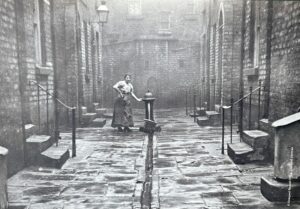
A typical courtyard in the mid 19th Century
The Police Bridewell
The holding cells in the Bridewell

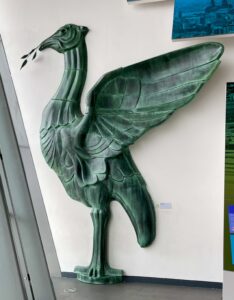
The Liver Building dominates this area, but if you’re a twitcher, you’ll be disappointed to discover that the Liver birds, the mascots of the city, that grace the two clock towers are not eagles or cormorants, which they appear to resemble. They are, in fact, mythical birds rather like a griffin or a phoenix. Originally they were bright but now the copper sheet metal has oxidised to green. They are called Bertie (looks over the city) and Bella (watching for returning sailors), each are 18ft high and have wing-spans of 24 ft.

Looking across Canning Dock
Model of a Liver bird in Museum of Liverpool

And having wondered for years where the term Scouser comes from, it turns out to be the name given to Liverpudlians because they used to eat a lot of scouse, a type of meat and veg stew, a recipe that they took a fancy to and brought back from Scandinavia.

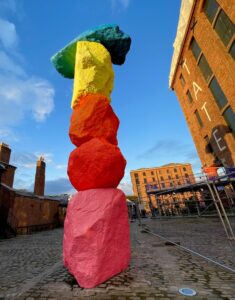
Liverpool Mountain by Ego Rondinone
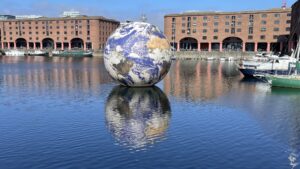
Floating Earth instalation
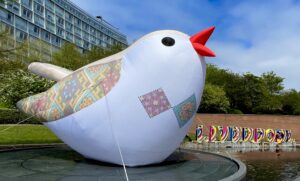
Ukrainian songbird

During our visit, Liverpool was gearing up to host the Eurovision Song Contest on behalf of the Ukraine. There’s a bit of a buzz about the place and a lots of people. It’s been a great visit, but time for a change of scene for us.

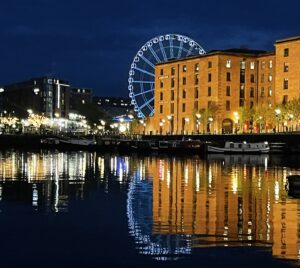
Night in Salthouse Dock
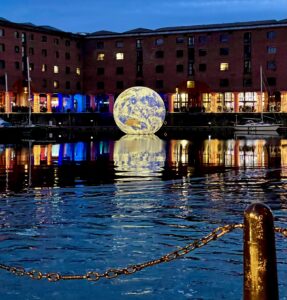
Floating Earth in the Royal Albert Dock


It’s so big!

Looking across Wigan Flashes from Moss Bridge

When we were young (that is BC – Before Children), we hired our first narrowboat from Burton upon Trent and cruised the Trent and Mersey Canal to Great Haywood before turning around and heading straight back. Since then, we have travelled most of the canals in the midlands and the south, but we’ve never headed further north then Astley Green on the Bridgewater Canal (where we once got iced in and had to smash our way  home). So this week is the start of a new chapter, for the first time in quite a few years, we are on a new canal and it feels like we’ve moved from a country lane onto a dual carriageway!
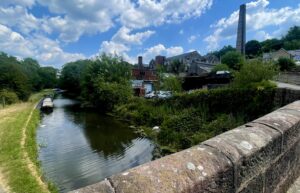
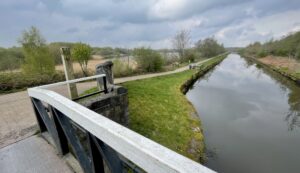
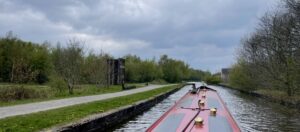
This is the Leeds and Liverpool Canal (L&L) and it’s a beauty. It’s deep and wide, built for big coal barges with reinforced edges to allow for bigger washes from the boats. We’ve been travelling along the Leigh Branch of the L&L canal heading towards Wigan, passing areas of outstanding beauty which are actually reclaimed slag heaps that have sunken and created beautiful flashes and wildlife reserves. This was the Wigan coalfield that had over thirty collieries operating during the 19th and 20th centuries.
Astley Green Colliery
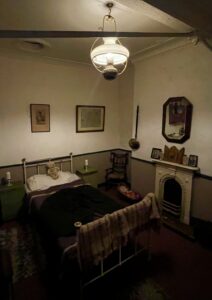
Upstairs in the miner’s cottage

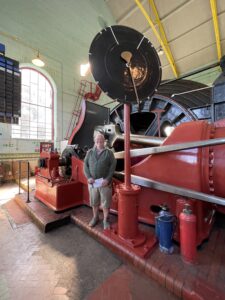
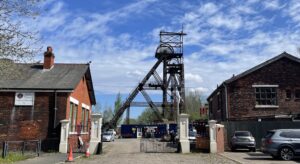
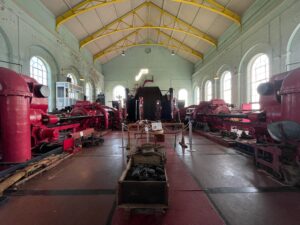
Last week, we visited the Lancashire Mining Museum at Astley Green Colliery (1908-1970). Most of the original buildings have been dismantled but No1 Engine House dominates the site and houses the largest surviving colliery winding engine of its type in Europe. It has four cylinders in twin tandem compound arrangement and can develop 3300 horsepower at 58 rpm. It’s now run on compressed air, and they operate it on published dates throughout the year. If you like engineering then this place is worth a visit as they also have 28 colliery locomotives, the largest collection of its type in the United Kingdom. There’s a replica miners’ cottage and opportunities to dress up for a photo shoot. The mine shaft was two and a half times higher than the Eiffel tower, that’s about half a mile deep. The under ground tunnels then stretched for over 3 miles out from the pit shaft. 

Inside No1 Engine House
Ian acting as a scale model for one of the four cylinders

Since 1983 the museum has been run by volunteers of the Red Rose Steam Society, some of whom are retired miners and their wives. Many are now in their eighties (possibly nineties) and keen to tell you stories of their lives and of the mine. In 1984 striking miners from Yorkshire arrived at the gates to set up a picket line – unfortunately for them, the mine had been closed for 14 years and the retired Lancastrian miners, who were at the site that day doing safety checks, laughed at them and pointed out the lack of cables running from the Engine House to the head of the winding gear.

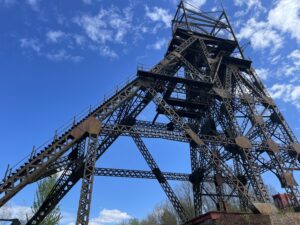
Ashley Green Colliery’s 98ft high lattice steel headgear

Walking back from the mine, we met an elderly gentleman standing on the canal bridge who was keen to reminisce about his life in the village. He pointed to the pub on the other side and said that in his youth the pub had been level with the canal, it now sits about 2 metres (6ft) below it. This amount of subsidence from the mining is obvious throughout this entire region, as the canal stands proud of the sunken landscape. Since the 1930s the canal has had embankments built up on either side with slag (waste from the mines) to keep it level and prevent it from breaching. This has happened to such an extent that two sets of original locks have been removed as the sides of the lower canal have been raised and the higher sections have dropped.

Ince Moss Flash- a haven for wildlife

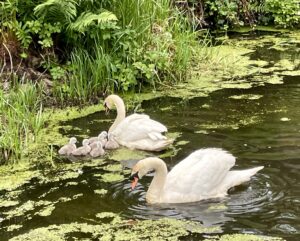
The Flashes at Wigan, lakes created by deep pits opening up, are now huge nature reserves and very popular with walkers, cyclists and twitchers (bird watchers). Spring is in the air with wildflowers unfurling on the banks and tiny ducklings scuttling along the edges of the water. The swans are nesting, and the weather just can’t seem to make its mind up!

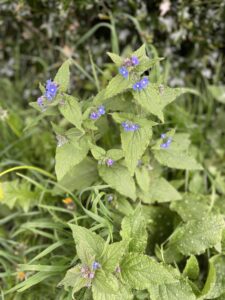
Green Alkanet
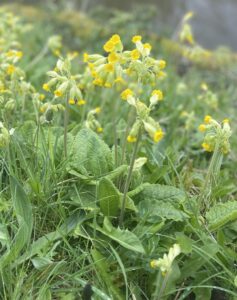
Cowslip primrose or Mayflower
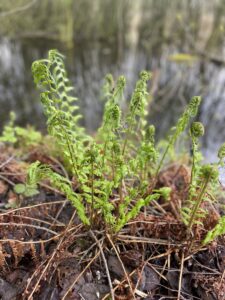
Unfurling fronds of Basket Fern
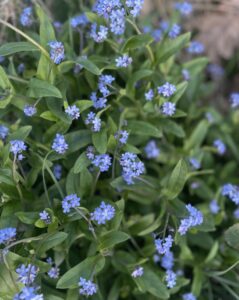
Forget-me-not
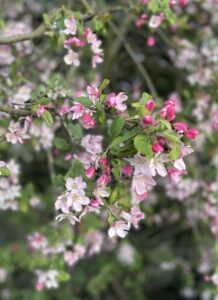
Crab apple blossom


Heading north

The closed entrance to the coal mines at Worsley

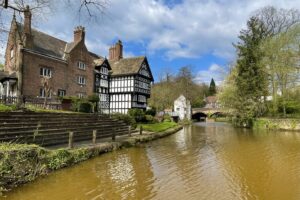
We’re on the move again and heading for higher ground! This stretch of the Trent and Mersey has taken us through three tunnels in two days delivering us onto the Bridgewater Canal – the first and oldest canal on the system. It was built by the young Duke of Bridgewater following his Grand Tour. He was inspired to start construction after seeing the canals that had been built throughout Europe. Opened in 1761, the Duke built it to provide a faster and cheaper route to supply Manchester with coal from his mines in Worsley. At its peak, over 3 million tonnes of traffic used the Bridgewater Canal and it forms a strategic link between the North and South canal networks.

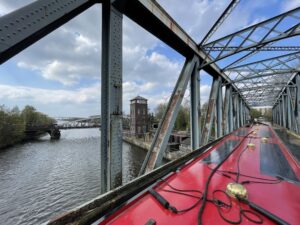
Crossing over the Manchester Ship Canal on the Barton Swing Aquaduct

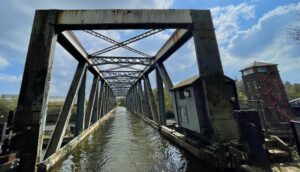
This week we passed over a unique feature which is known as one of the Seven Wonders of the Waterways. The Barton Swing Aqueduct carries the Bridgewater Canal over the Manchester Ship Canal. It’s not far from the Trafford Centre and is an amazing feat of engineering. An aqueduct is a stretch of canal built onto a bridge. But this one is special, both ends can be sealed off and the whole aqueduct can be rotated to allow tall vessels to pass along the Ship Canal underneath it. This is the first and only swing aqueduct in the world, opened in 1894 it’s now a Grade II listed building and is still in regular use today.

View back across the aqueduct

The first time we visited Worsley was in 2007 to view Meridian, the first shared ownership boat that we bought into. It was a brand-new boat and all very exciting. Ironically, we saw Meridian a few months ago and she’s still looking good. It’s still a shared ownership boat and I’m sure the person steering her on the day thought we were a bit bonkers as we waved at them with such enthusiasm.

Worsley Boatyard where we saw our first shared boat

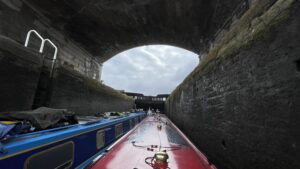
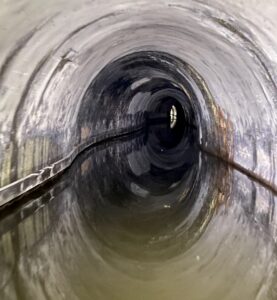
Our enthusiasm for tunnels has been tested on this stretch, as the three that we’ve just passed through were a little challenging. These canals were the first contouring canals to be built and the engineers struggled to find a solution to get past hills. Rather than building multiple locks to go up and over the hills, they opted to save time and money by creating tunnels  through them . The first tunnels to be built were at Barnton, Saltsford and Preston Brook. The tunnel routes were plotted across the hilltops and then shafts were sunk down. Miners dug in both directions from the bottom of the shafts and inwards from the tunnel entrances, theoretically joining up to create perfectly straight tunnels.

The bendy route of Saltersford Tunnel

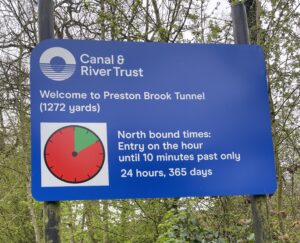
Instruction sign for passage though Preston Brook Tunnel

Unfortunately, this method of construction was on a learning curve (pardon the pun) and these tunnels have very obvious kinks in them. They are too narrow for boats to pass each other and not straight enough to see all the way through, so boats entering from each end would meet in the middle. To solve this historic problem the Canal & River Trust (CRT) have set up timed entries for each direction, which is great if everyone follows the guidance.

There are still over 50 tunnels on the canal network, ranging in length from 25 yards (23 metres) to over three miles (5,210 metres). You can get married underground in the Dudley Tunnel (Birmingham) as it now has a licence for civil weddings. The Dudley Canal Trust tugboat is used as the wedding vehicle with the ceremony taking place in the Singing Cavern.

Leaving Saltersford Tunnel

Some tunnels have not survived, Greywell Tunnel on the Basingstoke Canal was closed in 1932 after a roof fall. It’s now home to Europe’s largest bat colony, estimated at 12,500 bats of at least five species. Thankfully we’ve only come across stalagmites hanging down the inside of the tunnels that we’ve passed through!

Misty morning on the Bridgewater Canal