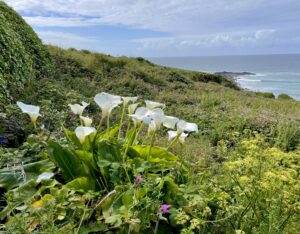
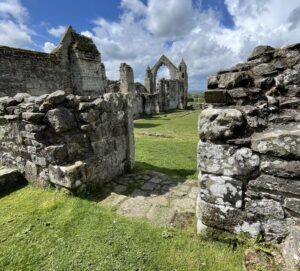
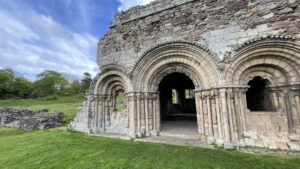
We’ve moored the boat in a marina, jumped into the motorhome and headed south towards Cornwall. We planned to stop off in the Shropshire Hills on the way down. Our first choice of camp location was waterlogged, so we found ourselves parked up at a campsite on Ebury Hill, previously an iron age fort. It has outstanding views over the Shropshire countryside and when the sun was shining, we chanced a walk along the Shropshire Way to the beautiful ruins of a 12th century abbey. This was our first taste of medieval history on this trip and it set me thinking about an old book that I’d seen as a child filled with the most amazing colour prints of dragons and knights. Of course, this was a book about King Arthur, and we were heading to Tintagel and the island where Arthur was born and built his legendary Castle, Camelot.
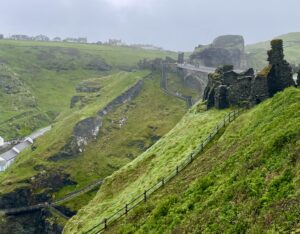
Except he didn’t!! What? Skip these paragraphs unless you’re prepared for disappointment. For starters it seems that castles didn’t appear in Britain until 500 years after Arthur. The ruins that we see today are the remains of a slate castle that was first built in the 13th century by Richard, Earl of Cornwall. A rich man with a romantic heart, his motivation to create a castle for Arthur was possibly from a newly published Book of Kings by Geoffrey of Monmouth. Geoffrey created the first account of a life story for King Arthur, stitched together from various myths and facts.
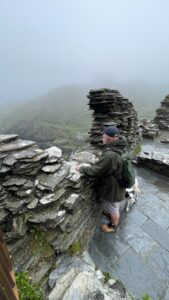
Arthur himself was likely a rather rough looking warrior as there was no shiny armour in the late 5th and early 6th Centuries AD, he would have been dressed in cloth and furs. This medieval Arthur did exist and was a prince who led British forces against the Saxons. His prowess in battles was exaggerated but as a talented fighter he provided an inspiring figurehead for the armies and was a conquering hero.
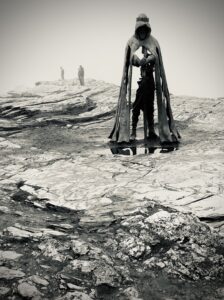
During the time that our legendary King Arthur should have been conceived on the island, it was actually a thriving trading harbour for goods from the Mediterranean. Remains of simple medieval, rectangular buildings used to store the goods can still be seen along with collections of glass and pottery from that period.
I’m a little disappointed that my shining knight never existed, but surprised by how old the story is. It’s fascinating that our passion for a good story can give so much credence to a name and international fame to a rocky outcrop.
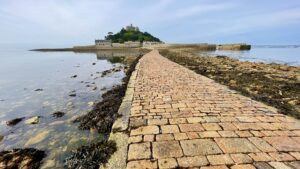
Further round the coast, the 15th Century castle and chapel of St Michael’s Mount dominates this shoreline. Close up the granite stone buildings look pristine (even the gracefully curving causeway has only one pothole!). Which is possibly why the castle has appeared in numerous films such as Dracula in 1979, Johnny English in 2003 and House of Dragon in 2021.
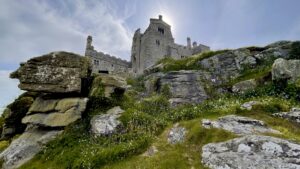
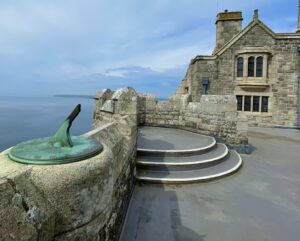
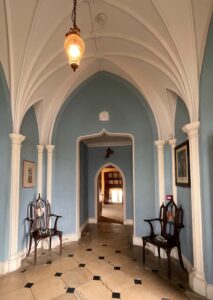
A 6th century legend describes the first habitant of this rock edifice as an 18ft high Giant called Comoran who terrorised the local villages. He was slain by a farmer’s son called Jack and you can find the heart of the giant as you walk up the cobbled path (it is small, but the guides usually mark it with fresh flowers every morning). Since then the island has been a priory, a garrison and a stately home. Inside the castle are remnants of over five hundred years of occupation including minute pieces of Napoleon’s uniform and some impressive Rococo decor!

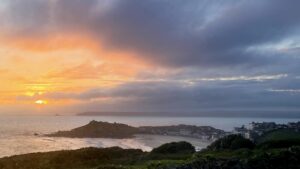
This has been a trip of 2 halves, so far. Torrential rain and getting stuck on waterlogged fields – twice! Followed by sun and blue skies, swimming in the sea and walking the coast path – barefoot for Ian.
We are now on the Lizard, the furthest south you can go in the UK. The sun is shining, the wind is light and we’re off exploring again. If you’re down this way and feeling peckish, our best tip for eating fish and chips is to have a friendly dog nearby to scare off the seagulls!
Fantastic 👍
Love the history and the story , esp the quirky bits – the stone heart and fresh flowers every day .
What a great holiday ❤️ xx
Sounds fabulous. What interesting adventures you are having!🙂
Glad to hear you are enjoying things.. 😎