If you thought nuclear bunkers are supposed to be secret, don’t visit south west Cheshire. There are signs to one all over the place, even next to the canal. If you want to know, it’s about 5 minutes walk west from bridge 85 of the Shropshire Union Canal. It’s on Google Maps too.
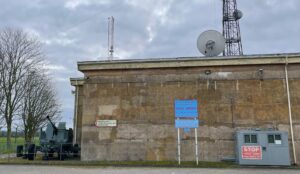 Growing up in the (showing our age) 70s and 80s, we were part of the generation who knew what it was like to live under the shadow of the Cold War and the threat of a nuclear attack. I vividly remember my Physics teacher describing what we should do if we had the four-minute warning.


He even gave us a paper dial calculator to estimate damage and rate of survival depending on how close we were to ground zero. I also remember watching the Government’s Protect and Survive film from 1976 and the rather devastating comic book and film from the 1980s by Raymond Briggs of “When the Wind Blows” (I had nightmares for years).
This is perhaps why I’ve had a morbid fascination to find out where the secret nuclear bunkers were and what it would be like to be in one. Allegedly, there are over 200 war bunkers spread randomly across the UK, some of which you can now visit as museums including Westminster, Liverpool, Fife, Hull and Brentwood. There’s even an underground city in Wiltshire, codenamed Burlington, it was built to house 4,000 people, it had its own subterranean lake, railway station and hospital.
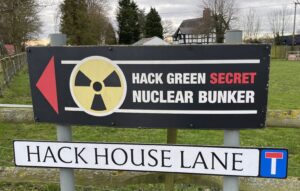
Like many of the war bunkers, Hack Green was decommissioned in 1991 after the Cold War ended and was later declassified in 2004. This one became a museum, but some have been sold as residential properties and one has even become a wine store. The Hope Cove Bunker, near Salcombe in Devon, is very similar to Hack Green both in style and history. It was sold for £433,000 in 2021. If you’re interested in owning a smaller observation bunker, there were over a thousand built and one was recently on the market for around £25,000. Access is down a 14ft (4m) vertical shaft, so it’s not for the faint hearted.
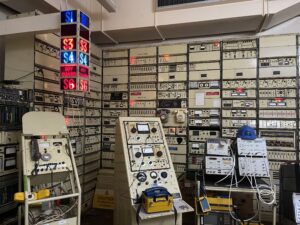 The Hack Green Nuclear Bunker was first operated in 1941 as a Ground Controlled Radar Station & Flight Control. At the end of WWII, it continued as an RAF Standby Radar Station. When I saw the signals room, it reminded me that my Dad served as a radio engineer in the RAF for his National Service. He probably worked on similar equipment, although he was based in the south of England.
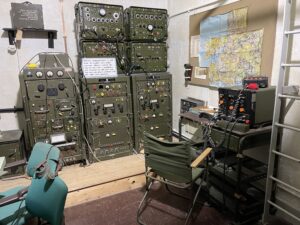
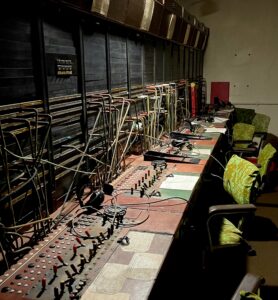
It wasn’t until a rebuild in 1979 that Hack Green became one of the Regional Government Defence Headquarters. At a cost of £32 million, approximately £140 million in today’s value, it was upgraded to withstand a nuclear attack for up to 12 weeks, housing 135 civil servants and military personnel.
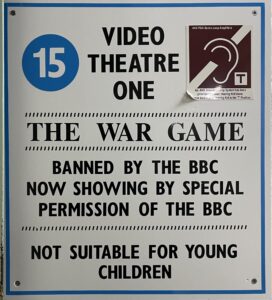 What was most poignant for me, was seeing the letters and handwritten messages that have been stuck to the upstairs corridor. These showed that the locals didn’t know that the bunker existed and also how scared parents were for their children’s future. It was quite shocking to watch a banned BBC film which plays in a downstairs theatre and is a re-enactment of how people in a town face the reality of a nuclear strike.
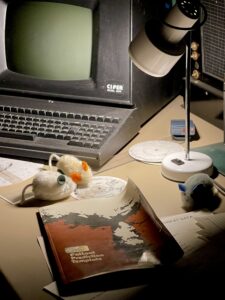
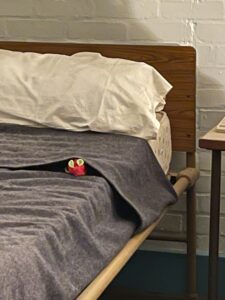
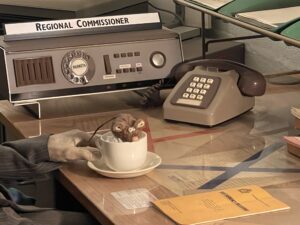
We never took our children around this museum, but if they had gone, the charity that runs this Bunker have hidden toy “Spy Mice” throughout the displays which would have created a little distraction for them. Walking through the exhibitions and watching the films is a stark reminder of how fragile our world is. I’m certainly grateful that the Cold War is over and I do hope that it stays that way.
Scary stuff!!
Thanks Heather- sobering stuff.
I have visited this bunker but had little idea of the ‘network’ of bunkers in Uk. We hear snippets on tv from time to time.
I don’t recall having that kind of input at school- like you I would have had sleepless nights .
Boom, oh sorry… wrong button 🤪
Fantastic piece of history there! I’d love to visit there next time I am in the UK….
Just follow the signs 🤣