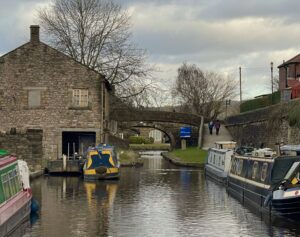
We have been cruising – off and on – along the Macclesfield Canal for over 30 years (I feel old!!). We were both born and brought up next to this canal. Our early years involved many walks along its towpath. When we were in our twenties, we started out as hire boaters. Our 2nd ever boat holiday started in Macclesfield, and was supposed to be the Cheshire Ring, but due to a breech on the Ashton Canal, we ended up doing the Macc and the Four Counties Ring. Boat hire stopped when the children arrived, but we had been bitten by the boating bug. When the kiddies were old enough to swim with life jackets on, we opted to renew our passion for narrow-boating and joined a shared ownership boat scheme which gave us three weeks a year. The first boat was a semi-trad narrowboat called Meridian and then we swapped to one called Ellen. These boats were based at Scholar Green, the first village along from the southern end of the Macclesfield Canal and the base for our family boating holidays. When we got our own boat, Heron, it became our home mooring in 2016 when we moved back to Cheshire.
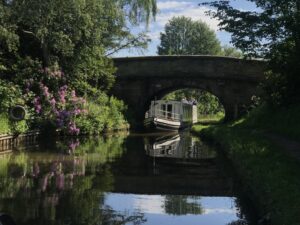
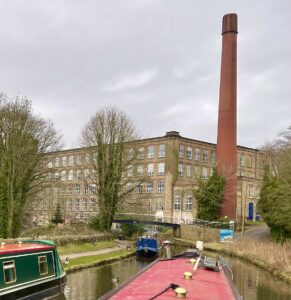
The Macclesfield Canal is a little gem. Designed by Thomas Telford, it’s 36.1 miles stretch between Marple and Stoke-on-Trent, providing a direct canal link between Manchester (Ashton Canal), the Potteries and the Midlands (Trent and Mersey Canal). In its hey day, the Macc provided transport for the cotton and silk mills, quarries and coal mines around Macclesfield, Congleton and the Peak District. Built as a contouring navigation, it follows a set height at two different levels through the countryside, using embankments and cuttings to keep the canal level for as far as possible. There is a flight of twelve locks at Bosley which accommodates the height change of 118 feet, 36 metres between the 2 levels.
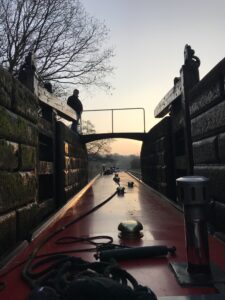
All canals need a supply of water especially on the higher summit pound (level) above any locks. Two reservoirs were constructed, at Sutton and Bosley, both have extensive feeder systems stretching back into the hills above the canal. Over the years they have suffered from serious leaks and the Macclesfield Canal Society have worked with CRT (Canal River Trust) to bring them back into production. Which (we hope) will eventually alleviate the water shortages that happen during dry summers.
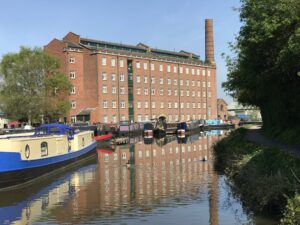
The Macc took just under five years to build at a cost of £320,000. That was pretty speedy for a new navigation being dug by hand by the Navvies (the workers were called “Navvies” as they were digging a Navigation). It was formally opened in 1831 by processions of boats from each end meeting at Macclesfield Wharf to a gun salute and the sound of “God Save the King” being played by the Band of the Macclesfield Cavalry. The canal proved to be a huge success and created an income of over £6.000 in the first year.
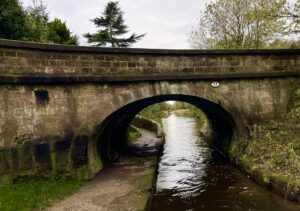
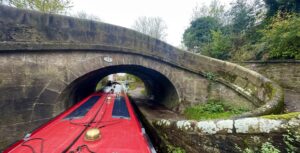
The Macc was one of the last canals that Telford designed, and he employed a lot of the solutions to problems encountered on previous canals. Many of its features are now Grade II listed including the five aqueducts (Biddulph Valley, Canal Road, Dane, Poole, Red Bull), all of the locks, the milestones, stone bridges, distance markers and stone fence posts and the entire length is subject to Conservation Area status.
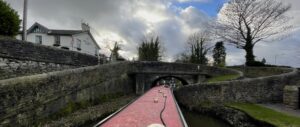
The first commercial boats were horse drawn and a solution was needed to get a horse on to the opposite side of the canal when the tow path switched sides. These bridges are usually quite a plain pair of ramps that the horse can walk up and over, unfortunately this caused delays as the horse had to be unhitched and retied on the other side. For the Macc, Telford designed a new solution which meant the horses did not have to be untied, these elegant and very clever roving bridges have a ramp on one side and a corkscrew path on the other, they are locally known as Snake, snaily or turn-over bridges.
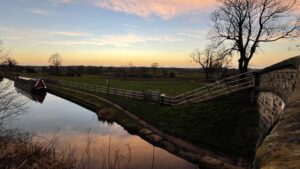
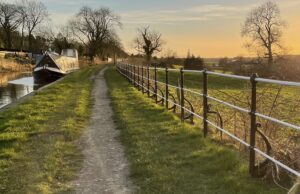
A striking feature is seen at Ramsdell Hall which overlooks the Cheshire Plain. The owner was refusing permission for the canal to pass in front of the hall as the usual towpath hedge line would block his view. To get the consent of the owner, the Canal Company agreed to provide an open decorative cast iron fence with gates. This unique fence line has now been restored by the Macclesfield Canal Society and continues to provide stunning views.
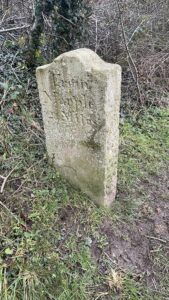
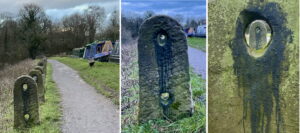
During the World War II, as with all road signs, the stone milestones along the length of the canal were buried. In the 1980’s, one of the first projects conducted by the newly formed Macclesfield Canal Society was to dig up and restore these markers. They even named their quarterly magazine after them!
The original southern end of the canal was at the Hall Green Stop Lock, where the Macclesfield joined the Hall Green Branch of the Trent and Mersey. This branch passes over the Red Bull Aqueduct above the A50 and then the Poole Aqueduct over the the Trent and Mersey mainline(it’s quite confusing on the map too), before taking a 90 degree turn to eventually join the mainline at Hardings Wood Junction. Hall Green Stop lock was where the two canals joined.
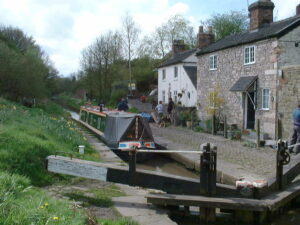
Canal companies were fiercely competitive, which explains why the lock was originally twice as long and had 3 sets of gates. This made 2 locks, one controlled by the Macclesfield Canal Company and one by the Trent and Mersey, and that’s why there are 2 lock-keepers cottages. The stone one for the Macclesfield and the rendered brick one for the Trent and Mersey. There are no lock-keepers now, the lock has been shortened and the Hall Green Branch is now treated as part of the Macc.
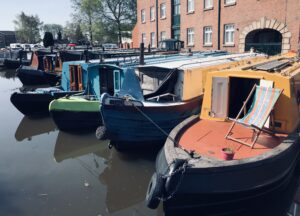
Macclesfield’s name was derived from the Old English name, Maccel, and field, yielding the meaning “Maccel’s open country”. The town is famous for its once thriving silk industry and was nicknamed “Silk Town” but strangely it has a second nickname of “Treacle Town”. This refers to a centuries-old accident when a horse-drawn wagon overturned, spilling its cargo of treacle onto the cobbles. The monthly Treacle Market is inspired from this and is well worth a visit https://www.treaclemarket.co.uk .
Having travelled the canal for many years now, I was quite surprised to spot something unexpected under one of the bridges. I sometimes look for a stone mason’s mark, (like a cross or triangle) these were used to ensure they got paid for the blocks that bore their mark, but this was carved in 1829, whilst the canal was still being built!

Fascinating history, thanks🙂
Nice update on your boating history & early days 👍
Lots of news about Macc and the local canals – we don’t always stop to think about those amazing bridges and smooth designs . thank you
And great pics as always
Love it xx
We even discovered there’s a hidden tunnel but we’ve saved that story for another day!!!