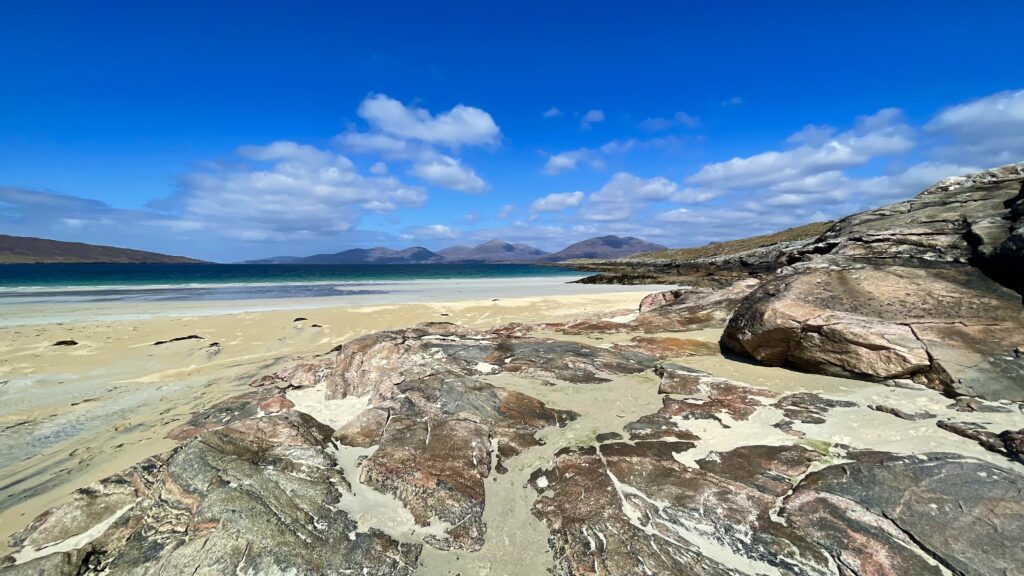
We crossed on the ferry from Uig on Skye to Tarbert on Harris and traded the majestic landscape of Skye for a moonscape of rocky outcrops. This pinkish white layered crystal is about 3 billion years old and is some of the oldest rocks on the planet. It’s called Lewisian gneiss and is believed to bring peace and healing. This rugged landscape frames the golden sands and the emerald green waters of the lochs. Ian is loving his dips in the sea, on one day he had three swims each one on a different beach and quite happily “Freezing my **** off!”. Personally, I prefer the air temperature to be above 10 degrees Celsius before taking the plunge into water that’s probably nearer to 5.
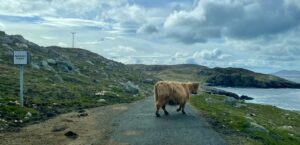
Harris and Lewis are really two parts of one island which has also been known as an t-Eilean Fada , Gaelic for The Long Island. The roads on the “Long Island” are mainly single track with passing places and either, very soft verges (gives you a sinking feeling), or steep side edges (not good to catch your axles on). We’ve had the joys of nudging past a range of beasties, from Highland Cattle, with massive horns that could rip the side of the van in half, to bleating sheep, wild goats (also with vicious looking horns) cute little ducks and strutting chickens with a death wish. Once past the mountain range, on the lower third of the island that separates Harris from Lewis, the landscape becomes a soft peaty moorland. The sparse landscape of the moors stretch out to the horizon, appearing bleak and empty. But dotted around are the shielings, small stone huts traditionally used in the summer to watch over cattle, which prove this to be fertile grazing land, rich in nutrients and wildlife.
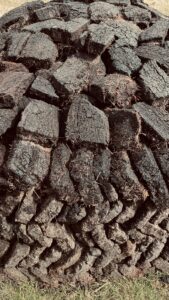
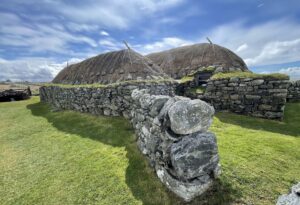
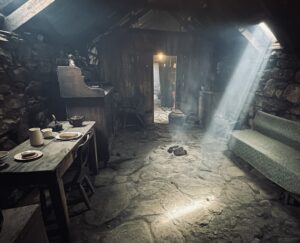
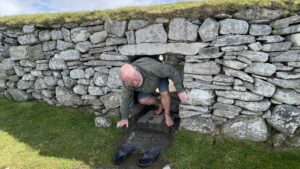
We saw a lot of evidence of peat cutting across Lewis. The right to cut the peat is specific to a property with profiles up to 20ft deep. The best banks have peat that’s denser and blacker, this higher carbon content burns hotter and longer. There were “cruachs” , or stacks of peat, at the Black House at Arnol. I thought the dried peat would be crumbly, but it was surprisingly heavy and hard with a deep earthy smell. Inside the thatched long house, the smouldering smoky fire keeps the thatch free of pests and rooms free of tourists, as they cough their way outside! Personally, I love the woody smell as it reminds me of home and campfires.
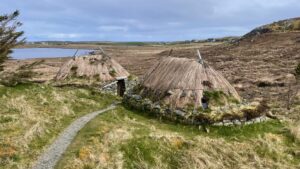
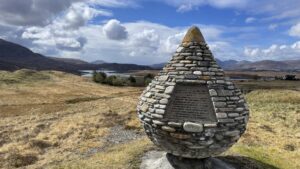
There seems to be far more evidence of human occupation on Lewis. From ancient stones, historical monuments, and memorials of past heroes to the sad sight of numerous stone ruins and derelict crofts. The migration away from the Western Isles started after the Jacobite rebellion of 1745, causing the clan system to end and breaking people’s ties to the land. This was followed by the “Little Ice Age” during the mid-late 1700’s, caused by falling volcanic ash from eruptions of the three famous volcanoes on Iceland– Katla, Hekla and Laki. These years became known as the Year of the Black Snow, Year of the Black Spring and Year of the White Peas (imported from Holland to avert starvation). Destinations for starting a new life were often in North America, particularly Carolina, New York and Pennsylvania.
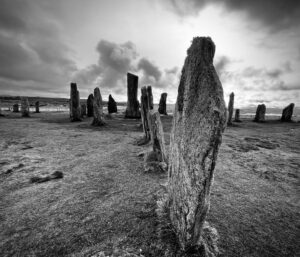
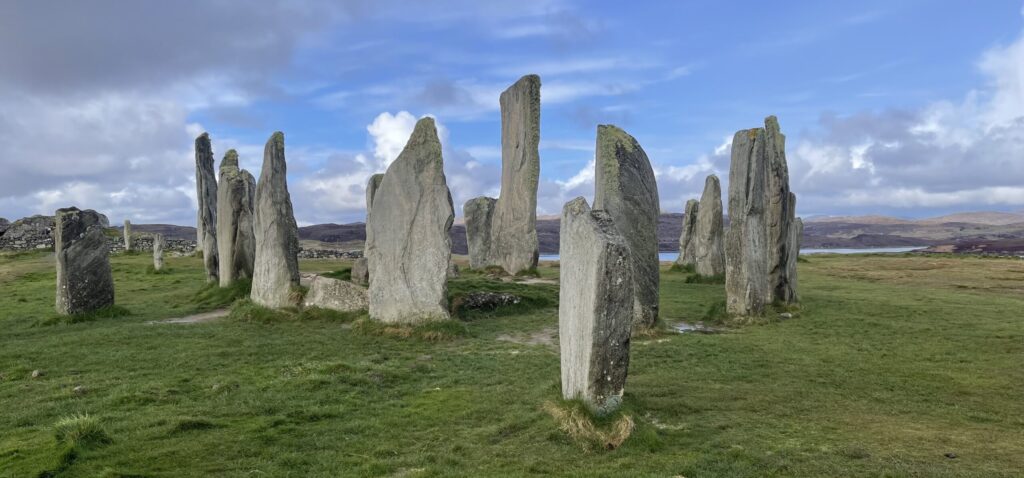
One of my goals was to see the main Callanish Stones site. We arrived earlyish and just managed to beat the rush. There was one person paying homage to the stones, so we did keep our distance. Weirdly, their voice was the only sound up there. It was very strange, but there was an absolute silence and a stillness to the air. As soon as we walked down the hill, we could hear every day noises and birds singing.
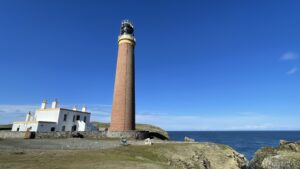
Our time on these isles has been blessed. We’ve seen sea eagles, and storm petrels and oyster catchers and Ian says he’s heard more cuckoos (but I think he’s making that up!)(No I’m not!!! – Ian). The weather has been kind and I’ve had another glimpse of the northern lights. It’s now time to catch the ferry from Stornoway, back to the mainland at Ullapool. We have discovered that we can tell how bumpy a journey has been by the amount of loo roll that’s unrolled itself and piled up on the floor in the shower room! It really can take an age to roll it back up again!
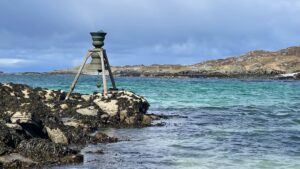
Learn about this and 11 other Time and Tide Bell here timeandtidebells.org
Amazing walk through history and geology.
Thank you for your witty blog ❤️
Thanks E, it’s great way to collect our experiences! Really enjoy getting comments so keep them coming x
That’s a lovely part of the world that I want to see myself. I spent a few weeks on Rùm, but never the outer part. Yes the pre-Cambrian rocks are very very old. You are so lucky to have ‘good’ weather too. Keep the reports coming..
Thanks Martin, we do appreciate the dry days and the sunshine was unexpected. You will have to get up here sometime x
Now you must read Peter May’s Lewis Trilogy.
Thank you for that recommendation- I’ll have a look on Kindle x
Great read and photos as always, thanks for sharing🙂
Thanks Ang, we really appreciate your support and comments x