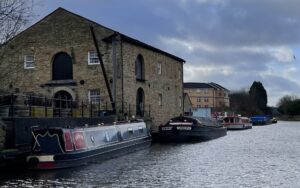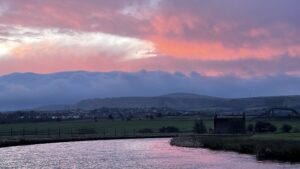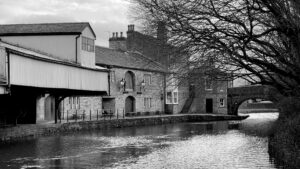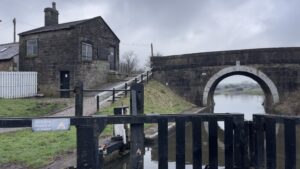
Classic Caldon

Etruria Junction

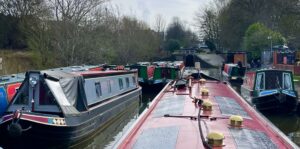
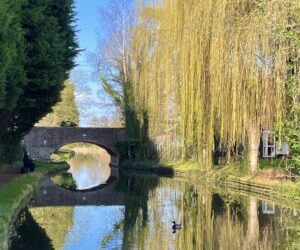
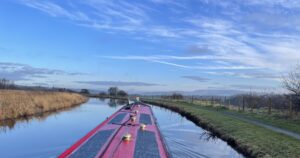
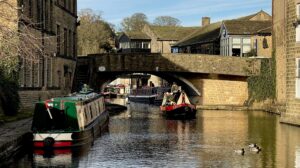
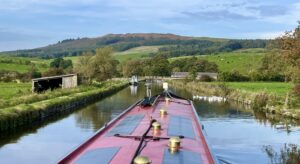
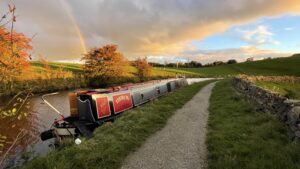
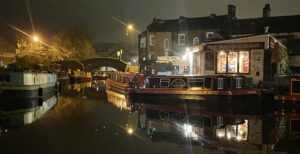
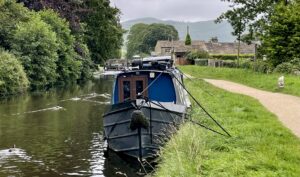
In years gone by (good grief I feel old!), we used to keep the boat at Heritage Marina on the Macclesfield Canal and a favourite 1 week trip would be south through the Harecastle Tunnel and up onto the Caldon Canal, one of the oldest canals in England (1776). This picturesque and contouring navigation was built to bring limestone down from the quarries at Cauldon Low to Stoke-on-Trent, joining with the Trent & Mersey at Etruria.
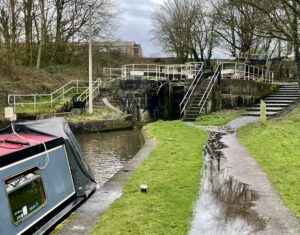
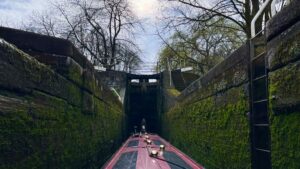
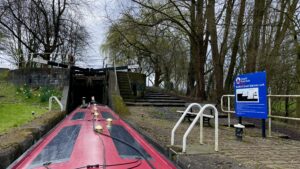
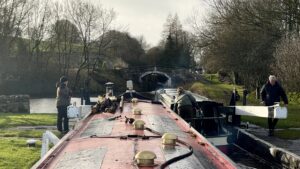
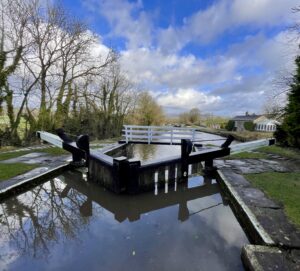
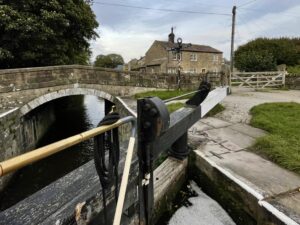
Heading up the Bedford Street staircase locks on to the Caldon


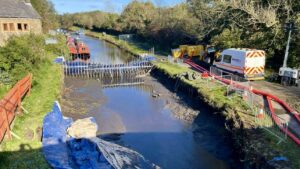
The upper limit is at Froghall, but sadly, the Uttoxeter Canal that used to join it here only lasted from 1811-1850. The Caldon & Uttoxeter Canals Trust are now working towards restoring as much of the missing 13 miles as possible. Meanwhile the short branch line heading off from Hazelhurst Junction to Leek still exists, however we couldn’t use it this time, as it was temporarily blocked by a sunken boat.

Down the weed hatch to clear the prop

Whenever we go up on to the Caldon Canal the first few miles often feel like you’re running a gauntlet. It’s a mixture of industrial and urban estates with some extremely low bridges and a reputation for unsafe moorings. In preparation for this, we usually moor up at Westport Lake and have an early start to dash up this first stretch to achieve the green fields near Norton. After here, it is a pretty canal that eventually parallels the River Churnet, winding its way along the valley through Cheddleton before joining the river through Consall Forge and then heading up to Froghall. Unfortunately, the river section was blocked with underwater sand banks so we had to turn at Oakmeadowford Lock. This was also a lucky call for us as the river went into flood the next day and we would have been stranded until it receded.
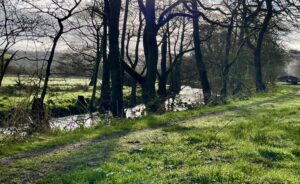
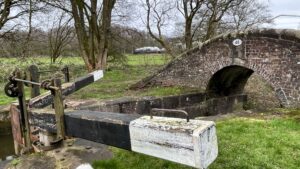
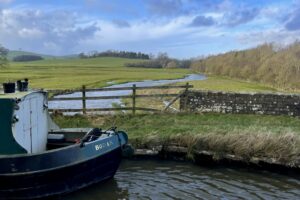
River Churnet and Oakmeadowford lock up ahead


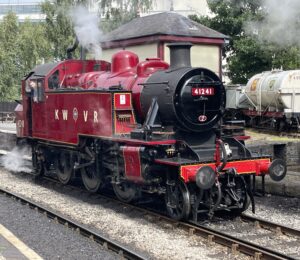
It was a beautiful, idyllic spot to spend a few days with views across the river and meadows to the railway line. The meadow is populated by pheasants, and we were relieved to see some did survive the gamekeeper’s gun as he walked through them (Sammy dog was not impressed by the noise and hid under the armchairs). As it was a weekend, the Churnet Valley Railway was running a steam train and made quite a spectacle with very distinctive toots echoing along the valley. On the Sunday we had a squelchy walk to the Black Lion pub at Consall Forge to join in the musical celebrations for St Patrick’s day. We also enjoyed a much closer view of the 75033 Cambian Coast Express engine as it passed by between Cheddleton and Ipstones.
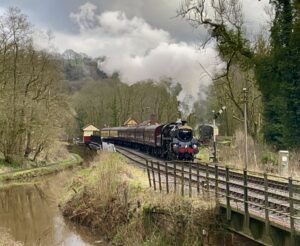
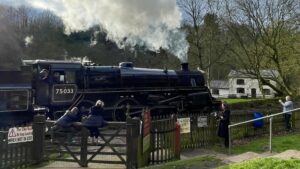
The Cambrian Coast Express passing the Black Lion
75033 passing through- toot toot!

There were also some warnings along the towpath telegraph (boaters’ gossip) of a potential breach that’s being monitored by CRT (Canal & River Trust) on the lock embankment at Hazelhurst. Should this deteriorate, it is believed that any repair would take a year to complete and, given our recent run of luck with stoppages, it was time to move!

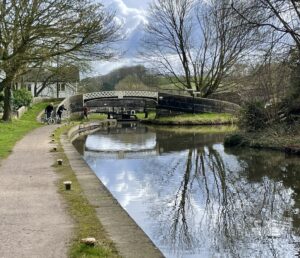
Landslip being monitored on Hazelhurst locks
Safe above the locks at Hazelhurst Junction


We are, now, back on the Trent & Mersey and heading south. As always, the Caldon Canal has been a hoot (or should that be toot!)
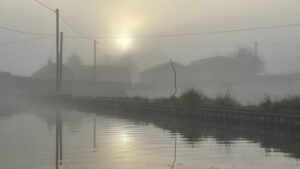
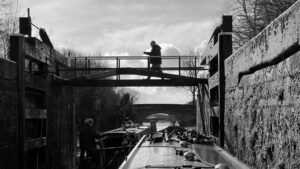
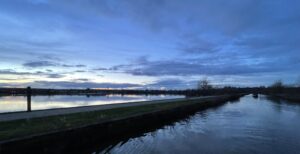
Moody dawn at Denford


We have descended!

Descending the Wigan Flight

It seems a lifetime ago, but after nearly 4 months of repairs, at 12:00 noon on the 23rd February 2024, the padlocks were removed from the top lock of the Wigan Flight and we were part of the first group of boats to make the descent. We paired up with some new friends and spent 5 hours chugging slowly down the 21 locks before heading around the corner to do 2 more on the Leigh Branch. It was going dark as we pulled in beside Scotman’s Flash, but we were extremely relieved to get there.

Arriving late at Scotman’s Flash Country Park

Over the following days we pootled along the Bridgewater Canal and moored up close to Dunham Massey. With dry weather and open countryside around us, we relaxed back into cruising mode whilst the shadows of the hills of Lancashire slipped away into the distance.

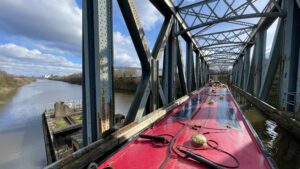
Passing over the Manchester Ship Canal on the Barton Swing Aqueduct

At Dutton Stop Lock (which was overtopping both the top and bottom gates) we sent up a cheer as we left the Bridgewater and finally re-joined the Trent & Mersey Canal. Then I said “all we need now is a kingfisher “and gave a squeal of delight, as a streak of teal blue did a flypast. Perfect.

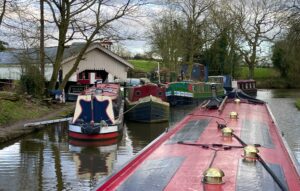
Dutton Dry Dock on the Trent & Mersey Canal

Heading on past the Anderton Boat Lift, we had another stoppage to get through at Middlewich. This was a planned replacement of some lock gates, the old ones having become too leaky after lasting 20 years. An impressive amount of time considering the battering that they take from the water and the boats.

Heading to the repaired Bottom Lock at Middlewich

After a few days of waiting, the sun came out and Spring arrived bringing blue skies and sunshine that was warm enough to dry off our mooring ropes (they have been wet, muddy, and rather heavy ever since leaving Skipton in December). We were now cruising in familiar territory along the plains of Cheshire, aiming for Wheelock Wharf where we moored up for a few days.

A favourite mooring near Crow’s Nest Bridge

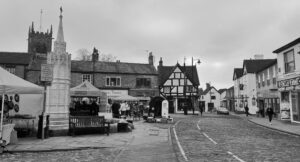
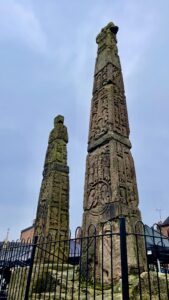
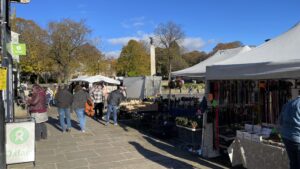
A walk into Sandbach town led to the sights and sounds of the indoor market and a Makers market. The latter being held on the cobbles by the old Saxon Crosses. This market place is surrounded by historic buildings that give a certain atmosphere that just reeks of times past with wattle and daub timber-framed buildings with old brick and stone work.

Market Place in Sandbach
Saxon Crosses Sandbach
Makers Market Monsters


We have lots of memories of past family holidays in this area and it’s fascinating to see how places have changed even in the few months that we’ve been “up North”. Time waits for no one it seems, but then again, some views are timeless.

Capturing the Northern Lights over the Plains of Cheshire.

Heading south – again!

Rose Grove Wharf, moored next to “Kennet” traditional L & L working boat

It’s been an odd few months, but we’re finally heading towards Wigan (again) in the hope that the Wigan Locks will reopen in a week or so. Apparently, they’re just about to pour the concrete!

Sunrise near to Huncoat

We’ve had our second anniversary of moving onto the boat and we’re feeling more settled – if that’s a way to phrase it when you’re constantly travelling!
Whilst it has been a rather gloomy and wet period, we’ve been cheering ourselves up with plans for this year and, we think we’ve hit the right balance of time cruising on the narrowboat, planned adventures in the motorhome and holidays on a cruise ship (or two).

Burnley Wharf

With such a cold wet winter, from November to January, we’ve been looking back at our fuel costs on the boat. For travelling and for charging batteries we’ve used about 200 litres of diesel, for cooking it’s been 1 x 13KG propane gas cylinder and for heating, 30 X 25KG bags of smokeless coal (yes, that is 0.75 metric tons!!). Total cost of around £800, and of course, we’ve been scavenging wood from along the towpath too (it’s addictive and very satisfying).


One of the vloggers that we follow on YouTube, who have a brand-new Hybrid narrowboat that is only powered by diesel (sounds backwards that, but there’s no sunshine for the solar panels in the winter) recently shared that they’ve spent about £750 on fuel for the same period. I’m surprised that their costs and ours are so similar, when their boat is probably worth about 5 x ours and is supposed to be much greener.

Johnsons Hillock Locks, Chorley

We’ve had a slightly mixed time on the Leeds and Liverpool Canal. The scenery has been dramatic, from industrial towns to stunning valleys of rivers and limestone gorges. But we’ve also had a few rough patches, we’ve been assaulted, the car was vandalised, and we’ve had a couple of incidents with young people being rather “playful”. It’s been a very eventful time but we’re ready to head back to more familiar territory for a while.

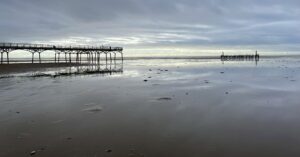
Pier end at St Annes
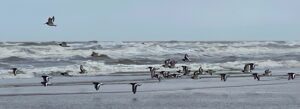
Oyster Catchers take flight

To blow away the cobwebs, we caught a train to the seaside and walked along St Anne’s Beach to Blackpool. The dog loved the open space, I enjoyed a bit of shell hunting and we all found it very cold and bracing. St Annes is a great traditional, seaside town. It was built in the late 1870s for the cotton mill workers of Lancashire to enjoy a never-ending beach with fish & chips and ice-cream on every street corner. Its romantic Victorian architecture reminds me of the resort in Jane Austen’s Sanditon, but that was most likely based on the Georgian town of Worthing in Sussex (so, that’s the wrong period and wrong end of the country!).

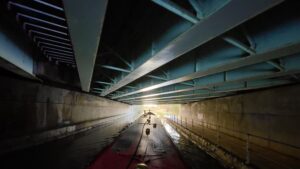
Passing under the M61 at Chorley

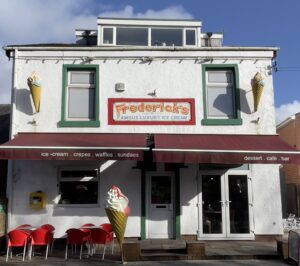
As we head south towards Wigan we made a lunch stop at the infamous Fredericks Ice Cream Parlour. Starting in 1892, four generations of this family have been producing 120 flavours of real Italian ice cream and of course, we had to sample their wares (2 flavours each not 120!!!)
Frederick’s Ice Cream Parlour
Every flavour ice cream
Naughty but nice!

Right now, we’re on the move again and it’s a joy to feel a little sun on our faces. It’s all very wet underfoot, but that also means that there’s plenty of water for cruising. The swans are beginning to get territorial again, particularly when they spot the dog. We’ve seen kingfishers and snowdrops, catkins and pussy-willows. It feels like Spring is just around the corner and we’re hoping that there’s some warm, sun-shiny days ahead.

Cruising over blue skies

Solving A Mystery

Crossing the aqueduct over the River Aire

A few days before Christmas, we cast off from our winter moorings in Skipton and popped into the canal basin, to replenish our stocks of diesel and coal at Pennine Cruisers. Even though we haven’t been cruising, we have used diesel to run the engine to charge batteries and provide hot water for showers; water for washing up usually comes from the copper kettle that lives on top of the multi-fuel stove in the saloon, quite basic, but costs nothing.

Blue skies above Nuttlebar Dyke

There is a plan to head south for the summer, but as the canal ahead of us is still dammed, and being repaired, we’re not in any rush. Travelling back to our hometown on public transport is about a five-hour journey, so we’re keeping the car nearby and taking it in turns to walk back for it and moving it closer to our next mooring spot. It’s a bit of a faff, but the walks are lovely, and it makes big shops and trips out so much easier. Once we’re past the stoppages at Wanless Bridge and Wigan Locks, we’ll resort back to buses and trains.

Lock sharing up the Bank Newton Locks
Lock 38 Bank Newton Flight of 6 locks

Choosing a sunny day, we moved the boat from Gargrave up the Bank Newton Locks. We shared locks with another boat, we made good time and caught up on towpath chatter along the way. When we last passed through these locks, the Canal and River Trust were re-mortaring them, so it was good to see them without the barricades and cement mixers.

Bottom of Greenberfield Locks. (near blue spot on image below)
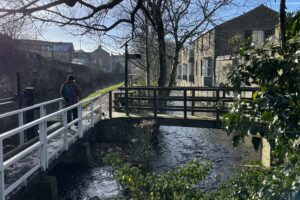
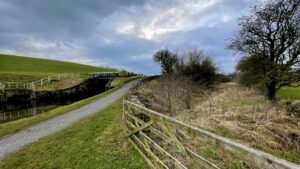
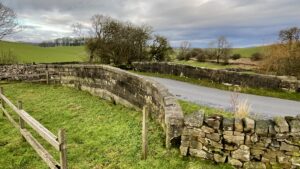
We tied up just below the summit level of the Leeds and Liverpool Canal close to Greenberfield Locks. We’ve moored here several times during the last six months, but it’s the first time that either of us spotted what looks like a disused stretch of canal and a rather odd arched stone road bridge (the type you’d expect to find over a river or canal) leading to the top of the locks. It’s odd because it’s almost buried in a field halfway down the hill! The section of disused canal seems to head towards it and at first glance looks like a feeder or large runoff from the summit level. Finally, there’s the curious sudden change in the angle of the canal above and below the lock flight. It was all quite puzzling, was this an old branch line that led to the house below the arched bridge? Perhaps an old wharf? There is a history of lime kilns in this area and the remains of one is supposed to be close by, but there wasn’t any obvious evidence of a wharf or local industry. Time for some sleuthing!

The partially buried road bridge
View of buried bridge from below

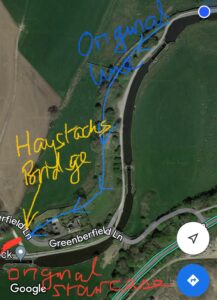
The mystery is solved. Opening in 1816, it had taken 46 years to build this contouring canal and the engineers had to choose between two types of locks to alter the height of the navigation. Individual locks in a flight such as at Wigan and Johnson Hillock or a staircase of locks joined together like the Bingley Five and Three Rise. At Greenberfield, they opted for a pair of deep locks in a staircase. Unfortunately, once opened, this proved to be a mistake as these locks used too much water to operate and were leaving the summit level too low for navigation. Within the year, the company  had to commission a new set of three shallower locks, creating a new curving section of canal that bypassed the original staircase and Haystacks Bridge. This was completed in 1820 and these are the locks we use today. It’s likely that the original locks were then buried with the waste material leaving only the parapet of the road bridge exposed. Haystacks Bridge now sits at the bottom of a picnic area. It’s a Grade II listed building and was, for a time, used as stables for the nearby cottage. 

The mysterious buried bridge in yellow, original canal in blue and location of original staircase locks marked in red (Courtesy of Google Maps)

I love seeing the old wharfs, bridges, and mills along the canals. The solutions that the engineers employed are often simple and elegant in appearance, yet deceptively complex in design. It’s fascinating to discover that sometimes, despite all the calculations and considerations, the plan didn’t always work. A bit like life, but we usually muddle through and find our way in the end.

A favourite view from the “Curly Wurlys” heading towards East Marton

Rocks, Rivers and Colourful Lights

Skipton Trip boats

Having brought the car up to where we’re moored, we’ve been out exploring the more remote areas of the Dales that the bus services don’t reach! 

Brinham Rocks

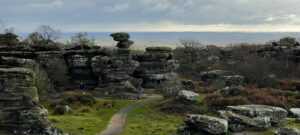
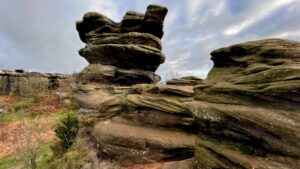
Our first big find has been Brimham Rocks near to Harrogate. You could advertise this place as a prehistoric theme park, it is 320 million years old! The rather unassuming moorland carpark belies the majesty of what lies ahead. Along the way you are led between huge towers of weathered, gritstone mill rocks that have enticing shapes, gaps and cervices between them.

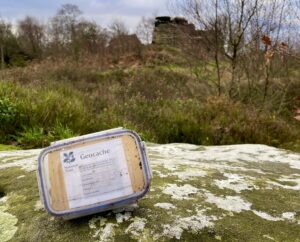
Great spot for geocaching (traditional style)
A “corny” micro cache!
Eagle Rock

Many of the rocks have names like Blacksmith’s Anvil, Eagle and Dancing Bear. The whole place has a curious atmosphere, like it’s been waiting for you to come and explore. The sheer scale of this ancient “rock garden” is very deceptive, whilst it’s tiny in comparison to the Grand Canyon, for a humble part of the Yorkshire Dales, it’s pretty awesome.

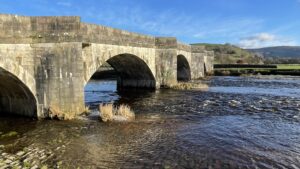
Burnsall Bridge 1609

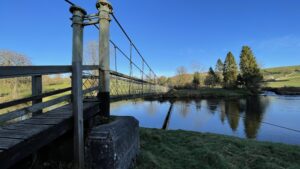
On a slightly sunnier, but decidedly colder day, we hopped over to Burnsall to walk a section of the Dales Way that runs beside the River Wharfe.  As the river levels are high, the stepping stones were impassable but a little, narrow, suspension bridge near to the village of Hebden, provided a safe crossing. This was built 138 years ago by the local blacksmith William Bell (good family name that!). We thought it was great and quite a swanky bridge to be in such an isolated spot, unfortunately Sammy (the dog) really didn’t enjoy the bouncy and slightly swaying motion (I almost had to drag her!) 

Cast Iron Suspension Bridge near to Hebden

This route dates back to Viking times, but there’s a more recent tale of a notorius, 18th century murderer called Tom Lee of Grassington. Tom is reported to have carried the body of his victim, Dr Petty, along the path to a bend in the river called Loup Scar where he threw the corpse down into the water. Dr Petty had threatened to expose Tom as a robber, so Tom waylaid him in Grass Wood and murdered him. The murderer was finally caught when his servant broke down and confessed. His body was hung on a gibbet beside Grassington Bridge.

Beside Skipton Spring Branch
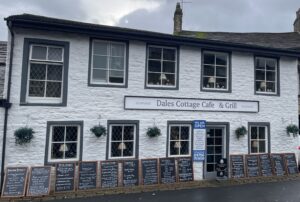
One of many cafes in Skipton

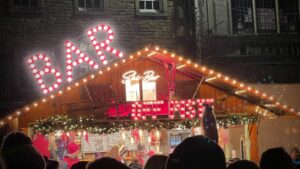
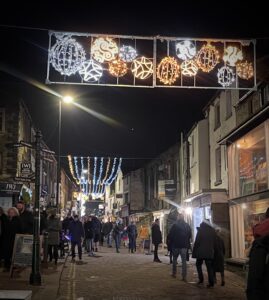
Back to Skipton and we are failing dismally at checking out the local cafes. This place is riddled with them, we’ve only been to one but there are over thirty within a ¼ mile of the town centre canal basin. And that’s not counting the many restaurants, pubs, and takeaways. We did go to the Christmas Lights switch on in the marketplace. It was a very merry event and quite a treat to have my first taste of traditional roasted sweet chestnuts.

Pop up bars, music and “snow”, make a merry scene
Skipton Christmas Lights

With a cold snap on the way we are mindful that the canal may freeze over, so we have done a quick dash down to the local boatyard to fill the boat up with diesel and replenish our coal supply. I will confess that, in the winter, I do enjoy scavenging for wood and kindling along the tow path, but this year I haven’t had to go very far. What has been very bizarre, espeically for a town centre mooring, is finding myself using the boat-hook to retrieve branches and logs out of the water that have just appeared beside the boat! It’s very kind of providence to keep us supplied!

Catching a glimpse of the Northern Lights from Rylstone Moor

The Heart of the Dales

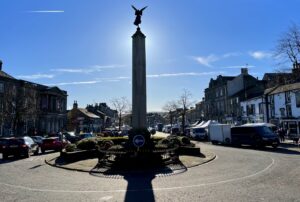
Skipton War memorial on market day

It’s been a busy few weeks and we are settled on our winter mooring in Skipton. As the boat is stationary, we’ve opted to bring the car up and use it for exploring. Ian’s been off to the woods and Malham Tarn whilst I’ve been recuperating from my second hand operation and planning for Christmas!

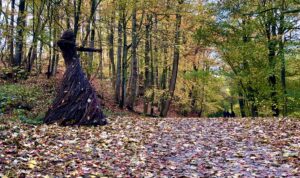
The archer in Autumn – Skipton Woods

Choosing a winter mooring is a bit of a gamble as there are only a few sites set up across each region of the system. Back in the summer, we’d started looking at locations across the north of England when these temporary sites were first posted. The cost varied depending on location and availability of facilities. As we like a quiet life, we’d settled on a couple of remote options that had water close by, but as you know, we changed our minds and were trying to get back to the Macclesfield Canal when the breach in the canal happened and we were surrounded by stoppages. By this point, the only spaces left for a winter mooring, that we could reach, were back in Skipton!

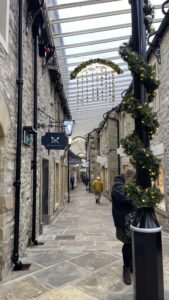
Alleyway to Craven Court
Skipton market
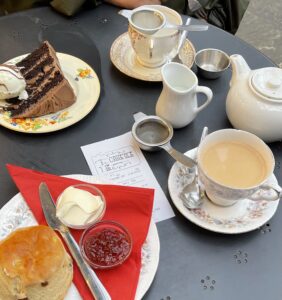
Afternoon Tea at the Cake ‘Ole Cafe

It’s very unusual for us to be moored so close to shops, people and lights. Skipton is full of charm and character, a Yorkshire town with lots of alleyways full of cafes and charity shops. The regular markets are a joy to wander around and remind me of the big Saturday markets that we use to have in my hometown of Congleton in Cheshire, a stall for everything and bargains galore. There’s even a very handy chandlers in the canal basin which is well stocked with ropes, fenders and all sorts of bits and bobs for the boat.

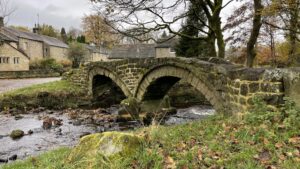
Packhorse bridge at Wycoller hamlet
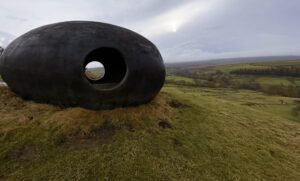
The Atom

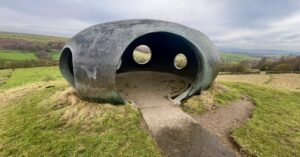
On a dry morning, we headed off back towards Pendle, to discover the aliens had landed near to a beautiful little hamlet called Wycoller. This sculpture, locally known as Atom, was one of several commissioned about 20 years ago to commemorate the renaissance of East Lancashire. It’s based on a panopticon, an 18th century design for prison cells around a circular space so that all the incumbents could be observed by a single guard. As bizarre as it looks, this curving structure sits rather well in this rolling landscape and frames delightful views in all directions.

The panopticon frames the views of Pendle Dale

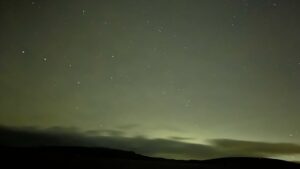
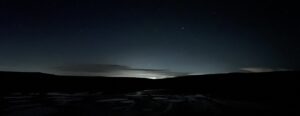
One of the attractions of the moorlands is how dark the sky is at night. I love star gazing and I’m a huge fan of the northern lights. Unfortunately, they didn’t dance for us on the nights we went out. But there’s hope! The sun cycle which repeats every 11 years is approaching a solar maximum, when sun flares and sunspots are more active. This increased activity means there’s going to be nights when the Aurora Borealis is visible across the UK, usually to a camera but occasionally to the naked eye. If you want to learn more check out this article on Live Science 

Catching a glimpse of the northern lights from Malham Tarn

There are apps and Facebook groups that you can follow to be alerted when an event is imminent, but it’s tricky to predict with lots of science to delve into. We’ll just take the easy option and moor up in the most remote places we can find to have the best chance of seeing them.

Back to the lights of Skipton and time to enjoy the local community and have a taste of Yorkshire. The first peculiarity that I’ve spotted was in the Fish & Chip shop, a Yorkshire Fish Cake, two slices of potato sandwiching minced white fish (cod or haddock) covered in batter (this is nothing like the much thinner breadcrumbed fishcakes that we get down south).

Yorkshire curd tart

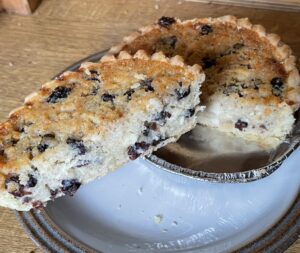
Then in a local bakery I saw a Yorkshire Curd Tart. Ian’s family is from Yorkshire and his grandma was a keen cook. He remembers having Curd Tart whenever they visited, it’s a bit like a curdled egg custard with dried fruit in a pastry case. It’s delicious despite the nick name that the family gave it, Turd Cart! (How rude!). I think I’m going to enjoy this winter mooring!


Star gazing on the moors

It’s Our Turn!

Heading back to Wigan again

In September we skipped off on a van trip to Dorset and returned to the boat (near the top of the Bingley Five Rise on the Leeds & Liverpool) with a decision to change our minds and head back to spend the winter on the Macclesfield and Peak Forest Canals.

Autumn days, near Greenberfield Locks
A handy cup of tea! 

I was really looking forward to an autumn cruise, I love the drama of the colours and lighting, the misty mornings and the toasty fires inside. But sometimes life has other priorities and events scupper your plans. This has certainly been the case for us through October and it looks like November too.  

I’ve had bi-lateral carpal tunnel syndrome (numbness and pains in both hands) off and on for most of my adult life and in the last couple of years it has deteriorated further. So I finally asked for help. During October I’ve been hopping off the boat to get the first one sorted.

Higherland Lock in Gargrave

But this wasn’t going to stop us from our cruising. Between travelling for appointments and surgery, we started moving the boat back towards Wigan. The Wigan Lock Flight currently has an emergency closure on it, but we were going to get through in the one week it would be open before a planned winter stoppage finally shut them until the New Year. The queues of boats waiting to go through this flight has been growing and is currently stretching to some of the towns just ahead of us at Adlington and Chorley.

Emergency repairs on the Wigan Flight. Photo Courtesy of Facebook

We had made it to the bottom of the Greenberfield Locks, just below the summit level, when we were notified of a new emergency closure on the canal just 6 miles ahead. There was nothing for it but to wait a week for the update and hope for a quick repair. Not this time. The estimate is 6-8 weeks. So it was our turn to be stuck. After much research of the planned winter stoppages and a long phone call to CRT (Canal River Trust) we are turning around again to head back to Skipton. I can think of worse places to be marooned!

Dams across the canal on the summit level. Broken culvert.

For the first time, we have opted to pay for temporary CRT winter moorings. This will allow us to moor at the same spot for longer than the usual 2 weeks. Our spot is in Skipton town centre, not far from the railway station, and I’ve already checked out the dates for the Christmas markets! We plan to thoroughly enjoy spending the rest of this year in North Yorkshire!

Skipton Canal Basin

A little trip

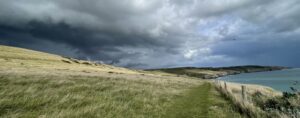
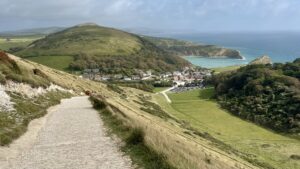
The dramatic Dorset Coast Path

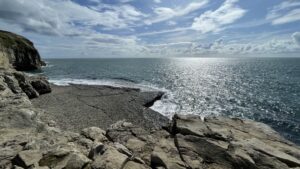
A bit delayed in typing this up, but in September it was time for a change of scenery, and we headed south in the van to the Jurassic Coast of Dorset. I think we were both a bit surprised by what we found on this trip. Dorset has got something for everyone, from military historians, palaeontologists, geologists, nature lovers or just lovers of fresh air and cold sea swimming (and yes, we did, on several occasions).

Dancing Ledge near to Langton Matravers

One thing we have learnt over the last couple of years is that we enjoy our travels more if we stay longer in one spot! That seems to be counterintuitive, but we used to move (and this applies to both the boat and the van) every day or every other day. Now we move to a new spot and stay for at least a few days if not a week  – the benefit of being retired. This gives us the luxury of time to relax and explore each place a little more than just dashing through.

Walking in the leafy New Forest

We started in the New Forest, went across to the Isle of Purbeck and then worked our way along the coast to Portland Bill and finally to Charmouth and the Cob at Lyme Regis.

Walking from Milford on Sea towards Hurst Castle

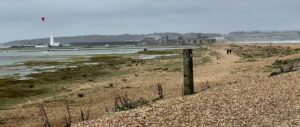
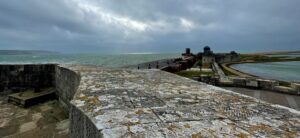
Whilst in the New forest we took a trip to Milford on Sea. We braced ourselves against gale force winds to walk along the spit of land to Hurst Castle. This exposed prominence is under constant bombardment from the sea. There have been multiple lighthouses here giving warning to seafarers. The castle has guarded the Needles Passage that leads to the Solent, the port of Southampton and the naval base at Portsmouth since the 1500s. These fortifications now stand as a tribute to all who have served within their walls from the Tudors to the mid 20th century.

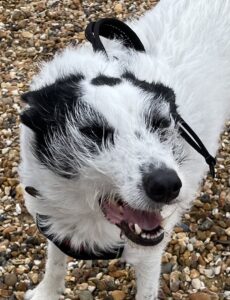
Sammy having a bad fur day
Looking across Hurst Castle from the Tudor Keep
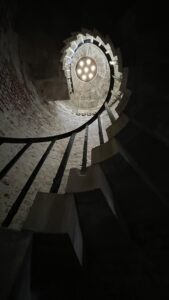
Spiral stairway inside Tudor Keep leading to gun platform

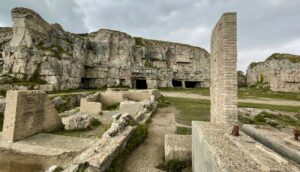
On to the Isle of Purbeck, we headed to Dancing Ledge. The ledge is just one example of the multiple abandoned limestone quarries that exist along these cliffs. Since the Middle Ages, Purbeck Marble (limestone) was shipped around the British Isles to be used in religious buildings from Chichester to York, including the arches and cloisters of Salisbury Cathedral.

Deserted Purbeck limestone quarries are scattered along this  coast line

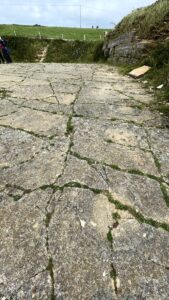
If you find yourself in this area, make a detour to the limestone pavement which captured the impressions of a dinosaur’s footprints

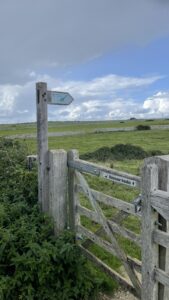
This way to the dinosaur!
Footprints  preserved in a mud layer


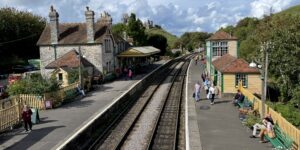
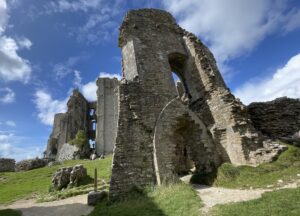
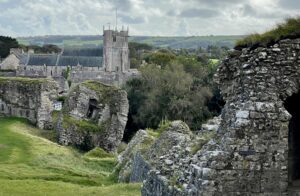
With the weather improving we jumped aboard a steam train in Swanage and headed to Corfe Castle. This regal ruin dominates the surrounding valleys. It’s dizzying heights and the outrageous angles of some of the remaining walls are rather alarming, but they do make for dramatic scenery and fabulous views.

Corfe Railway Station
Corfe Castle
Looking back to Corfe from the castle

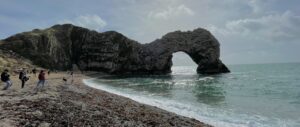
Lulworth Cove is a well renowned beauty spot, it was very pretty, but much smaller than I’d expected. This is where you can pick up the coast path and scale up steep staircases to find the most dramatic rock formations. The steps were just a bit too much for my knees but provided excellent exercise for the barefoot boater and his dog when they went in search of Durdle Door. This iconic limestone arch reaches into the sea- perhaps trying to get away from the throngs of visitors who flock to see it.

Lulworth Cove
Durdle Door

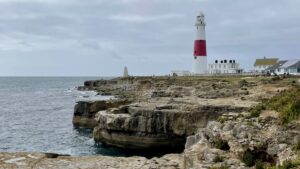
Back to the van and we headed on to the Isle of Portland and a campsite only a short walk from Portland Bill Lighthouse. Built in 1906, it was refitted in 2019 by the mariner’s charity, Trinity House with LED lights. This plot of land also has a very low magnetic field, making it an ideal location to test and calibrate sensitive equipment.

Portland Bill Lighthouse maintained by Trinity House

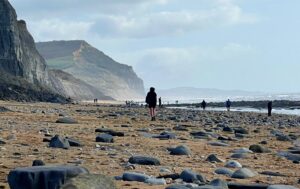
Our last few days were near to Lyme Regis and was my personal favourite. We stayed at Charmouth, and Ian went on a hike to Golden Cap (best walk of the trip) and I went fossil hunting!

Walking towards Golden Cap along Charmouth Beach

Fossil hunting was on my bucket list of things to do, and I will confess to being worried that I wouldn’t find any. So, I cheated and watched a few YouTube vlogs of fossil hunters to pick up some hints and tips. It seems that there are two main types of fossil hunters, those that search through the rocks and pebbles and those that smash their promising rocks to reveal their secrets. My “research”, as a searcher or mud larker, paid off and as I was delighted with my finds. However, should you go hunting and be unsuccessful, don’t panic, there’s an excellent little shop underneath the Heritage Centre where you can sneak in and purchase locally found fossils for just a few pounds. As my finds were quite small (tiny!), we bought a bigger ammonite to give to Grandma!
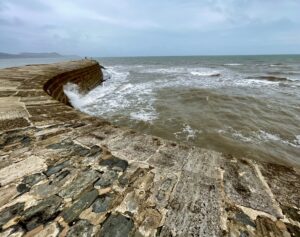
The Cob at Lyme Regis

A Grand Day Out

Top of Bingley Five Rise

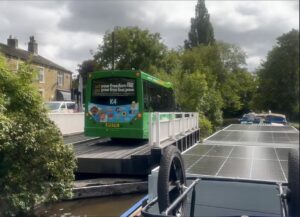
Since our last post, we moved along to Silsden for shopping and then headed to the top of the Bingley Five Rise to use the facilities. Along the way, we were a little horrified to see reports of an incident that had just occurred on the canal ahead of us at the Granby Swing Bridge, Riddlesden (near Keithley). A local bus ignored the flashing warning lights and tried to dash across the bridge as it was being operated.

Photo courtesy of Facebook group

The boater continued to open the bridge with the bus and its occupants sat on it. Now here’s the question, what would you have done when the bus drove onto the bridge and the barriers descended?
 Continued with the operation of opening the bridge, risking the bridge failing and the bus becoming stranded with the road closed for a longer period?
 Stop the bridge operation with the bus trapped by the barriers and call the police and the maintenance people for advice?
 Stop and try the close button to reverse the barrier action and allow the bus to drive away, possibly causing the bridge to fail? (They are very temperamental and don’t like to be interrupted)
My personal choice is I’ve no idea, I will find out if it ever happens to me! The nearest I’ve had to this is someone having to reverse their car as the barrier began to drop onto their bonnet! Thankfully when we got to that bridge, I saw the local bus drive over it just before we arrived.

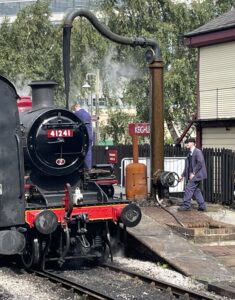
Engine manœuvres at Keithley Station


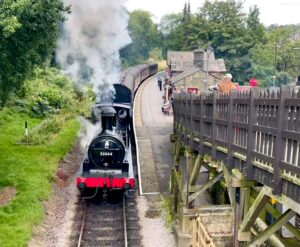
Having completed chores, we decided to treat ourselves by heading back along the canal to Riddlesden. The visitor moorings are only a mile (or so) from the railway station at Keithley, where you can also catch a Heritage Train. The Keithley and Worth Railway Line passes through Brontë Country at Haworth and has featured in multiple TV and films such as The Great Train Robbery (2013), Last of the Summer Wine (2006), The Railway Children (1970 and 2022) and Yanks (1979) to name but a few. We took a ride on the steam train and on the return hopped off at Haworth to investigate the town and the Parsonage where the Brontë family lived.

Haworth
One of the bedrooms in the Bronte parsonage

As it was a Bank Holiday, Haworth and the parsonage were busy and the walk from the station is quite steep in places, but it was well worth the visit. This experience has proven (yet again) how mixed up I get with literature and who wrote what. I basically thought that all the Brontë books had been written by Emily! But no, there were three Brontë sisters, who all published under male pseudonyms of Currer, Ellis and Acton Bell. Emily did write Wuthering Heights, but her older sister Charlotte wrote Jane Eyre and the younger sister, Anne wrote Agnes Grey and The Tennent of Wildfell Hall. Sadly, I also learnt that the Brontë siblings (including their younger brother) died comparatively young, primarily due to poor sanitation in the town.

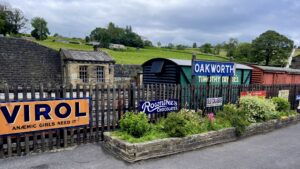
Platform at Oakworth Station – featured in The Railway Children

We got back to the railway station just in time to stand on the foot bridge and get “smoked and steamed” by one of the engines pulling away. The smell reminded me of my Grandmother’s coal fires, it was a lovely moment and completed my grand day out perfectly.

On the foot bridge at Haworth station

Doing the Dales

Gargrave moorings

In the last boating post, we mentioned a breach we were hoping would be fixed. Well – it is fixed. So we have moved on into the Yorkshire Dales. We made it to Gargrave and moored up there for a couple of weeks. The Yorkshire Dales are stunning, and as we had the car for a week, we went off exploring a little further afield to Malhamdale.

Higherland Lock, Gargrave

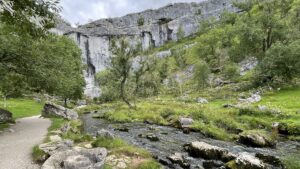
Malham Cove is 260ft (80m) high natural amphitheatre, the waterfall has been dry for over two hundred years, except… except for on Heather’s birthday in 2015, when an exceptional amount of rainfall caused the water to flow again. For one day only, this waterfall was the highest in England and higher than Niagara Falls.

Malham Cove

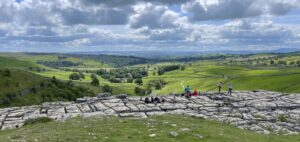
Above the cove is the iconic limestone pavement which appears in the Harry Potter film, The Deathly Hallows Part 1, and features in the 1992 film version of Emily Brontë’s Wuthering Heights and Steve Coogan’s The Trip. Ian remembers it from his geography classes and identifying the clints (limestone slabs) and grykes (fissures between the slabs), that lesson was bound to come in useful one day!!

Limestone pavement above Malham Cove

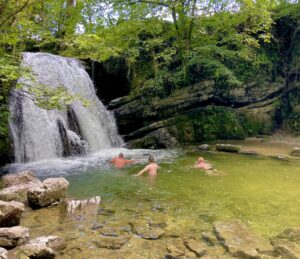
I think Ian has also developed a 6th sense for wild swimming spots. He swam at Janet’s Foss, a “secret” waterfall, on the walk back from Malham Cove. Not so secret though, it’s on all the maps. He had an audience and he wasn’t the only one taking a dip either. No one was staying in the pool for very long as it was colder than the North Sea (according to Mr B). Be warned if you ever choose to visit, there are tales of Janet, Queen of the Fairies, appearing as a glowing green column of mist that shape shifts above the water mesmerising the viewer with her beauty and then scaring them with visions.
Malham itself is a tiny little village described as the “honeypot” of the Yorkshire Dales with less than 240 inhabitants, it gets overrun by more than 110,000 tourists each year (guilty). It’s a sleepy place, nestled in the most beautiful valley but it has one mystery. In 2006, during a routine electrical safety check of the village hall, an electrician found a listening device (bug) hidden in a 13-amp socket. It had a range of several hundred metres and there was much speculation as to just what the listener was trying to hear. Was it the secrets of the parish council meetings? Or the gossip of the local WI? No one knows. The bug was handed over to the police for investigation!
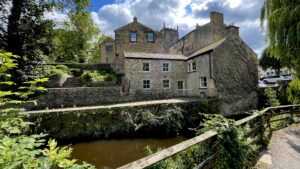
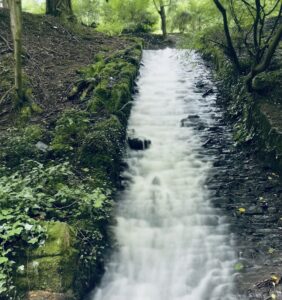
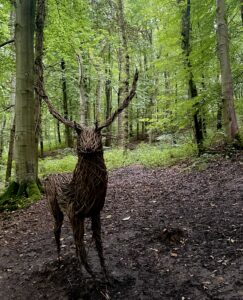
Springs Branch Canal, Skipton

Cruising on towards Skipton, the views across the valleys are simply stunning. A couple of days in Skipton gave Ian the chance to find Skipton Castle Woods. It’s a short walk from the canal basin along the Springs Branch Canal and past the castle. This is an ancient woodland that helped to power Skipton’s industrial revolution in the 1700’s. Two dams were built to supply water for the new local cotton and wool mills, whilst timber and stone were removed to help build them. The meandering footpaths and sculptures make it another little gem if you’re ever in the area.


We’re planning on spending quite a while on this next stretch of canal, cruising between Skipton and Bingley. These views are not to be rushed, and neither are the swing bridges! We are a bit flabbergasted that there’s twenty-one of them in just 12 ½ miles, all of them need either an anti-vandal key or a Watermate key to operate. Once unlocked, the majority are manual and accommodate farmer’s tracks or footpaths, but if it’s a road bridge then it’s usually electric. However, I’ve now been caught out a couple of times by what some boaters are calling a hybrid bridge. That’s when there’s an electric control panel to lower barriers and release the bridge from its mechanism but then you need to push it open manually (yes, I’m the one who has stood there waiting for the bridge to open itself). Every day is a learning day and these canals are keeping me on my toes!