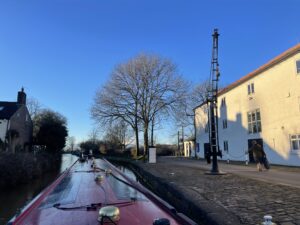
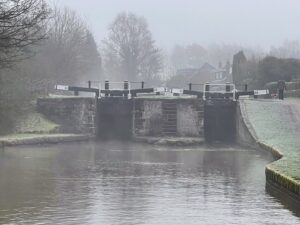
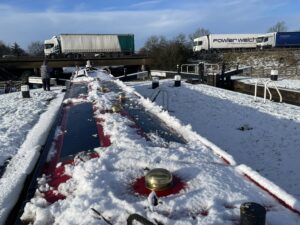
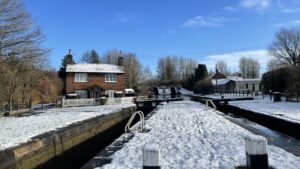
We’ve been heading down the flight of Cheshire Locks also known as “Heartbreak Hill”. I’d love to tell you a sad love story of how this nickname came about, but apparently it’s a relatively new name given by leisure boaters due to the sheer never-ending effort of navigating the hill. It stretches 12 miles from Kidsgrove to Middlewich with 31 locks. To speed up progress on the higher section, the original locks were built in pairs, but due to costs, the majority are now singles.
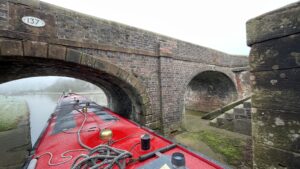
I hadn’t realised how local to the area the chief designer and engineer was. In 1727 at the age of eleven, James Brindley moved to Leek in North Staffordshire, working as a labourer on a farm his father had inherited. He was illiterate and uneducated but had a fascination for machinery, at seventeen he became an apprentice millwright and wheelwright in Sutton, Macclesfield. His new boss thought he was a bit of a bungler but changed his mind after Brindley saved the firm’s reputation by his work on a silk mill in Macclesfield and a papermill at Wildboarclough in the Peak District.
At twenty-six Brindley opened his own workshop in Leek and eight years later opened another in Burslem, in a building leased from Josiah Wedgewood. He worked on watermills and windmills and gained a reputation for advising landowners on their machinery. He worked hard and was often paid a wage that was less than a skilled mechanic. He had the appearance of a labourer, but his ideas were revolutionary, and it was the last fourteen years of his life that proved to be his legacy. It was Brindley who had the vision to build a series of canals to link the four main river estuaries, the Mersey, Trent, Thames, and Severn calling it the ‘Grand Cross’. It is understood that he once used a block of Cheshire Cheese to demonstrate his ideas to politicians in a bid to win their approval.
After Brindley had successfully designed and built the Bridgewater Canal, Josiah Wedgewood and his business associates invited him to survey a navigation to join the River Mersey and Trent together. Wedgewood wanted to have a safer route for his Porcelain and Fine Bone China to be exported and an easier route to import the China clay from the West Country. On completion the canal would stretch over 93 miles, have 76 locks and five tunnels.
During his later years, Brindley was hailed as a national hero, especially for triumphing over his poor beginnings. He was employed as the principal engineer on over ten canal systems and consulted on others.
Sadly, his health was poor as he suffered from diabetes and rarely took any rest. In 1772 at the age of fifty-six, he took to his bed. During the night he asked for a glass of water and is believed to have said “That is enough – I shall need no more.” He went back to sleep and died peacefully a few hours later. After his death, his wife tried to call in the monies owed for work that James had completed, but even the Duke of Bridgewater declined to pay up what he owed the family, implying that his needs were greater than theirs!
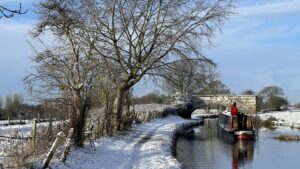
It was five years later that the Trent and Mersey Canal was finished. It was described as the “greatest civil engineering work built in Britain.” Although the canal cost £130,000 to build, it reduced the price of transporting Wedgwood’s goods from £2 10s to 13s 4d a ton.
Today, the section we are on is part of the popular Cheshire Ring, a leisure cruising route of 97 miles and 92 locks. If you’re feeling energetic the route can be done in a week. It takes you from the heights of the Peak Forest Canal along the arable plains of Cheshire and into the heart of the city of Manchester. That last part is on the Rochdale canal and passes underneath some of the office buildings, it’s quite a challenge and not for the faint hearted!
Makes me want to be a civil engineer!
And you’re one of the best!
Wow! Great photos and update. Thanks