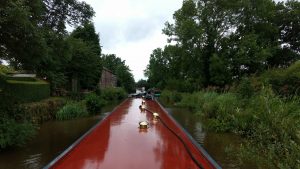
We’re home. And I might need another holiday to recover.
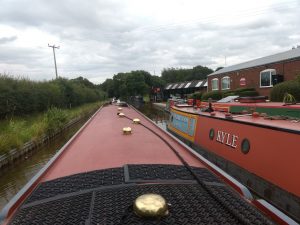
We ascended the Stoke Locks today. Over the past two days we’ve seen more boats moving than the previous two weeks. Today was no exception.
After lunch at Westport, we headed for the Harecastle Tunnel. We headed in as number 2 in a group of 4 after a 30 minute wait. Emerging from the northern portal, we turned left on to the Macc and on to our home mooring at Scholar Green.
How often can you say that you’re looking forward to Leicester? When you love your narrowboat and the English canal network you can. The Leicester Ring is a favourite of ours because it includes Foxton locks, the Trent and Soar Rivers, tunnels, narrow locks and wide locks. Leicester isn’t the best part, but if you’re doing the ring, you have to go through Leicester. And if you have to go through Leicester, by water is probably the best way.
We left our marina berth in Scholar Green this morning. Of course it started raining almost immediately. It’s a tradition now. We go off on our main summer boat trip and the weather changes to wet. It doesn’t really bother us, unless it’s really heavy. Normal English soft rain is fine. Just so long as we get some dry days…
We headed south, towards the Trent and Mersey and the Harecastle Tunnel. We rounded the last bend before the northern portal, fully expecting to see the usual queue of boats. The Harecastle is only wide enough for 1 narrowboat at a time, and there is no tow path. Boats gather at the tunnel entrances and are then sent through in groups by the Canal and River Trust (CRT) Tunnel keepers. But this time, there were no boats waiting. I immediately assumed that this was because we had just missed being able to join a group of boats heading south. But I was rapidly proved wrong. The Tunnel Keeper waved us into the tunnel. Following a quick test of horn and headlamp we ventured into the tunnel.
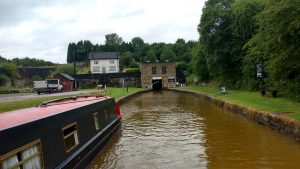
Exiting the Harecastle Tunnel
The Harecastle is narrow and the roof gets very low in the middle due to mining subsidence, the same subsidence that closed the parallel tunnel that allowed for two way operation. With a tunnel like this, it can be very easy to begin oscillating from side to side, eventually banging into the tunnel wall. The cause is actually, not enough speed. With higher revs, you get better, more immediate steering response. The boat is easier to control as a result. At slower speeds, steering response is sluggish, causing you to over correct, and zig-zag.
It takes around 40 minutes to get through the tunnel and we managed it without touching the sides. And it was still raining on the other side.
Now the goal was to get through Stoke before mooring for the night. Stoke on Trent is a great place to visit for shopping, or the cinema or for restaurants. There’s even a Cultural Quarter. It’s just not the prettiest place for an overnight canal mooring.
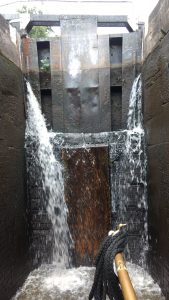
Stoke Top Lock – first of many
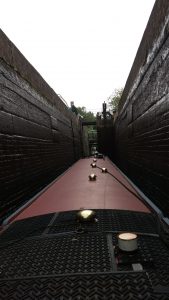
This meant getting through the locks in the Stoke flight. These 5 locks are some of the deepest and the last two seem deliberately embedded in other transport infrastructure. One is so close to a railway bridge that it makes the bottom gates hard to open and close. And the bottom lock takes you down into a concrete cutting under one of the A500 junctions. For some reason the canal is hidden away along here. Most drivers on the A500 have no idea the canal is there. It does mean, us boaters can feel smug when a narrowboat at 3.5mph is faster than the cars and trucks!
After the Stoke flight, the canal winds its way through a landscape that used to be full of heavy industry, but is now populated by huge warehouse distribution centres and the Stoke City football ground.
After one more lock at Trentham we moored for the night in the countryside near to the Wedgewood factory.
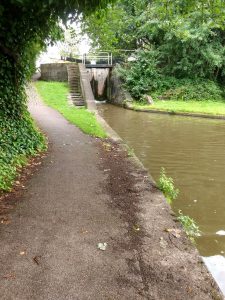 We ascended the Stoke Locks today. Over the past two days we’ve seen more boats moving than the previous two weeks. Today was no exception.
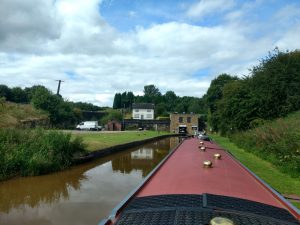 Emerging from the northern portal, we turned left on to the Macc and on to our home mooring at Scholar Green.