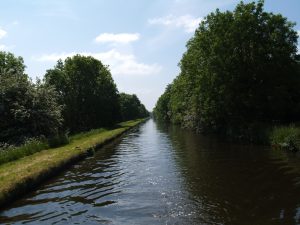
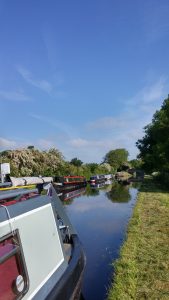
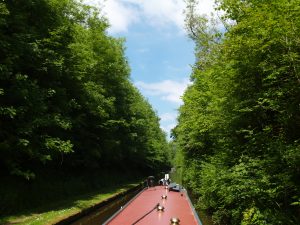
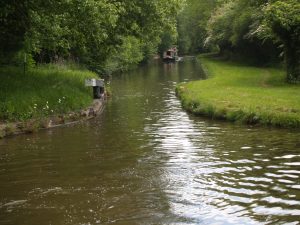
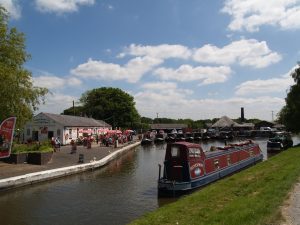
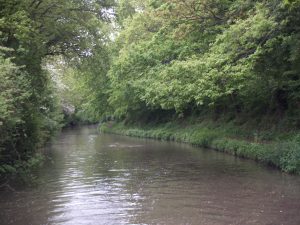
It is so long since I have been on the Shroppie, I forgot how straight and not narrow it is. This canal really doesn’t care about the details of the landscape, it just pushes its way through. Embankments alternate with cuttings, and today there was even a tunnel. I think the only straighter thoroughfare could be the Roman Road. Like Watling Street (aka the A5) that we passed over today. Yes, over, not under. Very weird feeling, gliding serenely over lines of traffic. Actually that’s a lie. There was roaring of engine as I stopped the boat to take a photo. You know me, I like that juxtaposition shot. I took a few, they are all useless and boring.
Bright and Clear at Brewood
The day started bright and clear, and despite weather predictions saying rain should be moving over from the east, it hasn’t happened yet. But I will admit it has clouded over now. In fact, the weather we had today was my sort of perfect, sunny but with a light breeze. It was warm enough, that the roof-dog eventually fell asleep on the roof. For about 5 minutes.
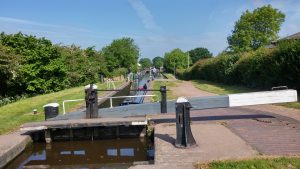
Wheaton Aston Lock
Only one lock today at Wheaton Aston, but this was the first proper lock on the Shroppie. We’re going down again. Yet again, my luck held, a hire boat was just entering to come up. Two very helpful crew stayed behind to get me started in the lock.
There are water points below the lock, so I took the opportunity to fill up with water. And then just after the next bridge, I took advantage of some of the cheapest red diesel I have seen. Unusually, it was being sold by a garage and not a boat yard. Very reasonably priced and very friendly. I can recommend Turners Garage.
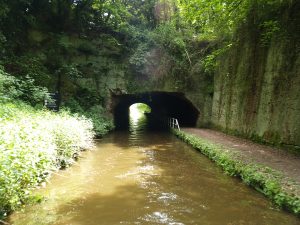
The Cowley Tunnel was on our route today. This tunnel was cut through solid rock and was going to be longer, but the roof proved to be unstable. Most of it, apart from a very short section, was removed. What remains is a long, very steep sided cutting through the solid rock.
Cowley TunnelDeep Cutting at Cowley
Embankments can make a canal vulnerable to losing a lot of water. Breaches are not unknown, there were even concerns about this during wartime in the 20th century. As a result, most of them are protected by gats like this one. If well maintained, they should close automatically when there is a significant water flow through them.
Protecting embankments
Bustling Norbury Junction
I arrived at Norbury Junction in time for a late lunch. Probably good that I arrived when I did. Most of the Wolverhampton Boat Club arrived shortly after me, taking most of the available mooring spots. They are out on their annual Commodore’s Cruise. One WBC boater warned me about the potential for traffic jams at some of the lock flights further north. He said they had experienced some challenges. I decided not to point out that when you travel in a group of 12 boats, you are taking your own traffic jam with you.
Looking forward to meeting up with Heather tomorrow, provided she can find Norbury Junction. It may be a bustling centre of canal activity, but for the rest of the world it is in the middle of nowhere.
Finding somewhere to moor for the weekend that was close enough to a pub with a car park where Heather can park for Saturday night. That was today’s goal. Turned out there were only 2 choices Ansty or Hawkesbury Junction (aka Sutton Stop). I decided to try for Ansty first. It was before Hawkesbury, which I know can often be busy, and as turning round in a 57ft narrowboat needs some planning…
As it was going to be a short day, I started later than normal. (The fact that I didn’t get to bed until 2am because I was playing with the new printer has nothing to do with it!). A lot of boats were on the move today, which added to the fun. Everyone seems to like complimenting Sam the roof dog.
Wooded Seclusion
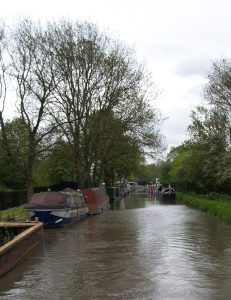
A lot of this section of the Oxford passes through pretty traditional English mixed woodland. For me that makes mooring tricky. Not because it is hard to moor in woods, it’s no different or more difficult than mooring anywhere. In fact, when we first started boating, first hiring and then on shared ownership boats, we used to favour woodland mooring spots. But tastes change, I now prefer a mooring spot with some form of wider view. And having heard several tales from other boaters of having branches or even complete trees fall on their boat, why should I take the risk. We just had the roof painted, you know.
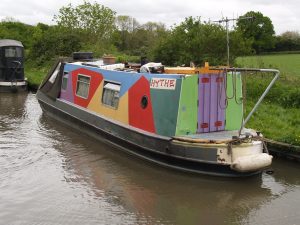
Colourful Camouflage
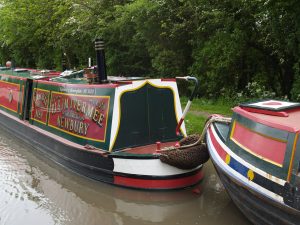
My impression is that there are a lot more boats moored around here. Certainly the variety is greater. I found myself taking much more notice and many more pictures. The boats ranged from the creatively colourful, like this example which I’m sure I’ve seen before when we were based on the K&A. I have convinced myself that the owner modelled the design on wartime ship camouflage but with a colourful twist. Another version of colourful was the more traditional paint scheme on this traditional motorboat and buttyboat pair (butty is slang for buddy or mate). After the advent of engines, this was the commonest cargo carrying configuration on the narrow canals. Both the motorboat and the unpowered butty had space for cargo and could be operated by a 2 person, often man and wife, crew.
Traditional Motorboat and ButtySo many different styles of bow
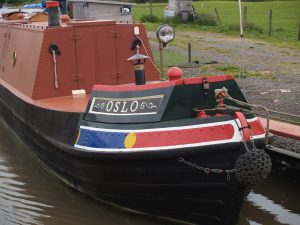
What you also realise is that there are many styles of bows on boats, like this one modelled after a traditional front cabin. I started taking pictures of each different type that I came across. But then I stopped myself when I realised how boat-nerdy/trainspotter-like that was.
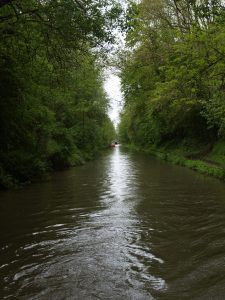
Typical North Oxford Long Straight Cutting
On the run into Stretton Stop, you enter a long straight cutting, another typical feature of the North Oxford, and also a result of it being straightened. This one is not as stable as it might look. Part way along the cutting, the offside has become unstable and parts of it have fallen into the canal, causing a couple of underwater obstructions that are now marked by big orange buoys. These also reduce the usable width so that only 1 boat can pass them at once. The signs plead with you to slow down to prevent further erosion, but not everyone complies. This was particularly true of the boat that was hurtling down the cutting towards the narrowed area that was currently occupied by Heron. Despite his lack of reading ability, his boat handling ability is very good. That was one of the neatest narrowboat emergency stops I have ever seen.
Stratton Stop is often a hive of activity as there is a hire boat base here, as well as lots of moored private boats and a boatyard. Friday is obviously a change-over day for this fleet because there were boats stacked 2 or 3 deep, whilst being cleaned, fuelled and
Busy at Stretton Stop
serviced. Stretton Stop gets its name from the narrow section here. This was used to house gates to hold back water if there was a problem with the embankment that was created here as part of the straightening. It was also used to gauge boats passing along the canal so that the right toll, based on weight carried, could be charged. The narrow section is now bridged by a small swing bridge, which can catch the unwary boater out. The narrow section before the bridge isn’t long enough to fit a 57ft boat. Also, you need to be on the non-towpath side to operate the bridge, which means, if you are single handed, you have to walk down the side of the boat to get off. So I approached with a slight sense of trepidation, which was completely removed when a one of the staff of Rose Narrowboats kindly opened the bridge for me. Thank You Whoever You Are – you disappeared before I could say thanks in person (first Marillion reference – I said I would manage it).
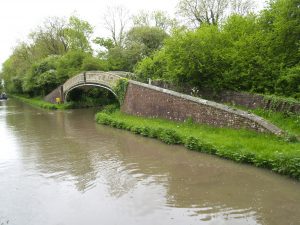
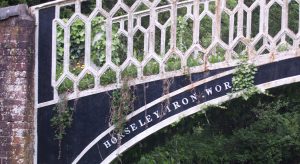
Typical North Oxford Cast Iron Bridge over disused armHorseley Iron Works Bridges
Along the North Oxford, you come across a lot of these attractive cast iron bridges manufactured at the Horseley Iron Works in Birmingham. Again, they are a consequence of the straightening work. This cut out many extravagant loops of canal from the mainline. But many of these sections also served import canal customers, so they needed to remain connected. Where the loop leaves the canal on the towpath side, a bridge was needed. A great example of early “mass” manufacture.
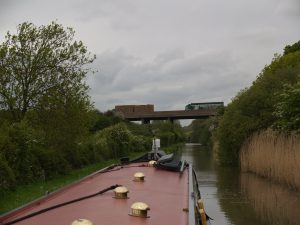
2 different versions of speed
As you approach Ansty, other, faster modes of transport begin to intrude. First is the M6. It passes over the canal on a high bridge, and is a constant source of noise. My family knows I am a fan of the juxtaposition picture. I always try to capture the comparison between canal travel and other more hurried modes. They are almost always less than successful. A static picture can’t convey the noise or the movement and just ends up looking like a boring photo of trucks and a bridge. So here is a boring picture of trucks and a bridge. Take it from me, that’s a fast section of canal (4mph is possible if you want) and that’s often a fast section of road. Immediately after the bridge there was another opportunity for a juxtaposition shot. The railway line comes to with just a few metres of the canal and follows the line of the canal for nearly a mile. A great opportunity to capture a shot of a speeding Virgin train in the same frame as a speeding narrowboat. Trains were coming thick and fast, one every couple of minutes. Well I kept trying, but the dog kept getting in the shot, and the boat still needed steering, and those trains are fast. By the time I realised I could slow the boat down to tick-over, and I remembered that the camera had a motor-drive mode that would take 5 shots in quick succession, there was a pause in the train schedule. When the pause was over, the railway was further away and behind some high bushes. Typical. It’s hard to take shots of trains from the back of a moving boat with an affectionate roof-dog.
Now I am moored in Ansty and looking forward to Heather’s visit tomorrow. Now, let’s go and explore some of those footpaths that are on the map I just printed out with my new printer.