Today was about canal contrasts. It is remarkable how much changed in the 60 or so years between the completion of the Staffs and Worcester and the Shropshire Union.
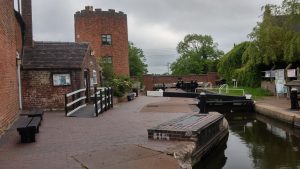
First job this morning was to get through the last lock in the Gailey flight, Gailey Top Lock. There is an interestingly ornate tower next to the lock. It is actually a toll keepers house. It has handy windows looking in both directions. Perhaps the martial appearance was intended to intimidate boatmen. These days, its use is a little more prosaic, a gift shop.
A very friendly group from a boat waiting to come down helped me through the lock. They claimed there was a fee for the service, but when I offered them biscuits, they politely refused.
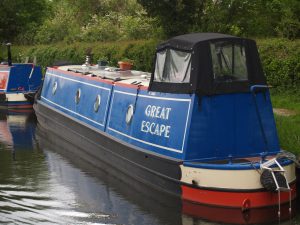
Shortly after the lock, I passed a boat that could have been named by a Marillion fan. The Great Escape is a favourite of mine and many other fans from the album Brave.
I realise I may be reaching a little. The Great Escape by Marillion has themes of mental illness and suicide. Possibly the boat owner has a different type of escape in mind.
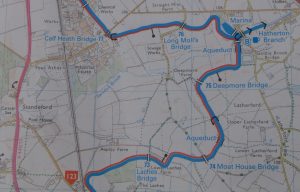
This section of the Staffs and Worcester shows its age. It is an older canal. After a flurry of locks yesterday, now it lazily contours its way to Autherley Junction. In a number of places, yo have to negotiate sharp bends, sometimes doubling back on yourself. Of course, that’s where you will invariably meet an oncoming boat.
Just prior to Autherley Junction is a roughly half mile length of very narrow canal, apparently known as Pendeford Rockin’. The canal was cut through rock and was left as only as wide as one boat. There are a couple of passing places. This is another location where you can guarantee meeting oncoming boats, and someone will have to reverse. It certainly happened to the boat leaving the narrow section just as I arrived.
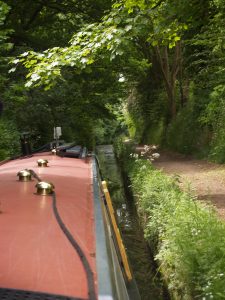
For a refreshing change. I met nobody.
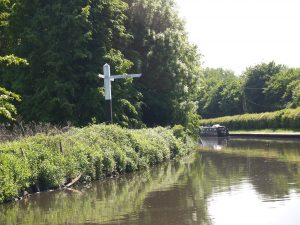
Next was the sharp turn at Autherley to join the Shroppie. The sign helpfully points the way, reminding you that this canal joins Birmingham to Chester and then to the Mersey Estuary beyond. A key route for cargo connecting the industrial heart of England to the major port at Liverpool.
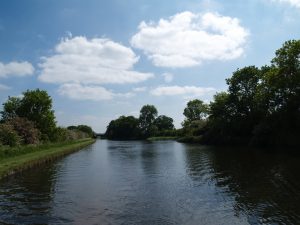
A group of young lads were spending their half term helping boats through the stop lock at the start of the Shroppie. Very helpful. It was whilst standing there, letting them do all the work, that I my first chance to notice the contrast to the canal I had just left. The canal ahead of me was wide and almost arrow straight. The Shroppie was completed 60 years after the Staffs and Worcester. Canal building technology had moved on, allowing them take much more direct routes. This canal makes extensive use of both embankments and cuttings to force its way through the landscape on a much more direct route.
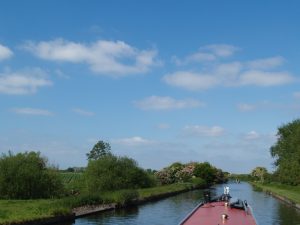
That’s not to say this canal is wide everywhere. It also has its narrow sections. But they are more the exception than the rule. In fact, in places it gets even wider, getting close to the width of Tixall Wide.
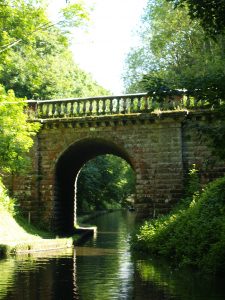
As is often the case on the Shroppie, cutting follows embankment. The first of these, when you are heading north, is on the way into Brewood. As cuttings are a frequent part of this canal. They had to have a solution to bridging them. It comes in the form of these elegant tall stone bridges.
We moored up just after Brewood. Embankments are always favoured places to moor. You always get a better view, even from just being a few feet higher than the surrounding countryside.
The only “disasters” of the day came after mooring. Sam doesn’t really like swimming, but she had a go tonight. That’s being generous. She fell in the canal whilst trying to retrieve her ball. Now the boat smells of wet dog.
Then I threw my dinner on the floor. Ho hum.