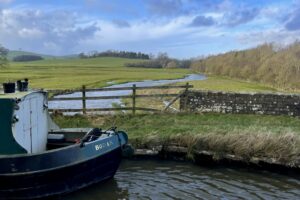
A few days before Christmas, we cast off from our winter moorings in Skipton and popped into the canal basin, to replenish our stocks of diesel and coal at Pennine Cruisers. Even though we haven’t been cruising, we have used diesel to run the engine to charge batteries and provide hot water for showers; water for washing up usually comes from the copper kettle that lives on top of the multi-fuel stove in the saloon, quite basic, but costs nothing.

There is a plan to head south for the summer, but as the canal ahead of us is still dammed, and being repaired, we’re not in any rush. Travelling back to our hometown on public transport is about a five-hour journey, so we’re keeping the car nearby and taking it in turns to walk back for it and moving it closer to our next mooring spot. It’s a bit of a faff, but the walks are lovely, and it makes big shops and trips out so much easier. Once we’re past the stoppages at Wanless Bridge and Wigan Locks, we’ll resort back to buses and trains.
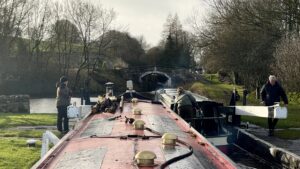
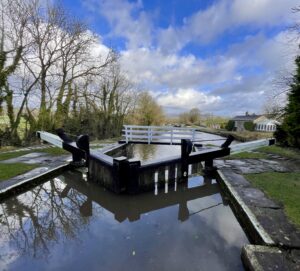
Choosing a sunny day, we moved the boat from Gargrave up the Bank Newton Locks. We shared locks with another boat, we made good time and caught up on towpath chatter along the way. When we last passed through these locks, the Canal and River Trust were re-mortaring them, so it was good to see them without the barricades and cement mixers.
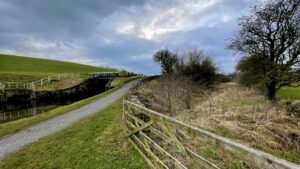
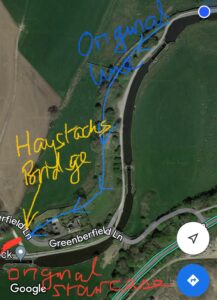
We tied up just below the summit level of the Leeds and Liverpool Canal close to Greenberfield Locks. We’ve moored here several times during the last six months, but it’s the first time that either of us spotted what looks like a disused stretch of canal and a rather odd arched stone road bridge (the type you’d expect to find over a river or canal) leading to the top of the locks. It’s odd because it’s almost buried in a field halfway down the hill! The section of disused canal seems to head towards it and at first glance looks like a feeder or large runoff from the summit level. Finally, there’s the curious sudden change in the angle of the canal above and below the lock flight. It was all quite puzzling, was this an old branch line that led to the house below the arched bridge? Perhaps an old wharf? There is a history of lime kilns in this area and the remains of one is supposed to be close by, but there wasn’t any obvious evidence of a wharf or local industry. Time for some sleuthing!
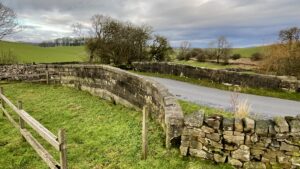

The mystery is solved. Opening in 1816, it had taken 46 years to build this contouring canal and the engineers had to choose between two types of locks to alter the height of the navigation. Individual locks in a flight such as at Wigan and Johnson Hillock or a staircase of locks joined together like the Bingley Five and Three Rise. At Greenberfield, they opted for a pair of deep locks in a staircase. Unfortunately, once opened, this proved to be a mistake as these locks used too much water to operate and were leaving the summit level too low for navigation. Within the year, the company had to commission a new set of three shallower locks, creating a new curving section of canal that bypassed the original staircase and Haystacks Bridge. This was completed in 1820 and these are the locks we use today. It’s likely that the original locks were then buried with the waste material leaving only the parapet of the road bridge exposed. Haystacks Bridge now sits at the bottom of a picnic area. It’s a Grade II listed building and was, for a time, used as stables for the nearby cottage.
I love seeing the old wharfs, bridges, and mills along the canals. The solutions that the engineers employed are often simple and elegant in appearance, yet deceptively complex in design. It’s fascinating to discover that sometimes, despite all the calculations and considerations, the plan didn’t always work. A bit like life, but we usually muddle through and find our way in the end.
Mystery solved! Great bit of sleuthing! Happy new year.
– Tim
Happy New Year to you too- hope you had lots of festive fun x
Fascinating, nice bit of sleuthing there. Hope there is not too much snow for all that walking..
No snow- yet! Freezing temps on their way for following week🥶
Wonderful update and case solved !
Happy north of England exploring 🥳